ADVERTISEMENT
ADVERTISEMENT



India’s global rise takes center stage at the Harvard India Conference 2026
Held across Harvard Kennedy School and Harvard Business School, the conference examined how India is navigating a defining decade.
-
 Avantika Panda
 - Wed, 18, Feb 2026
- 00:51 EST
- 397
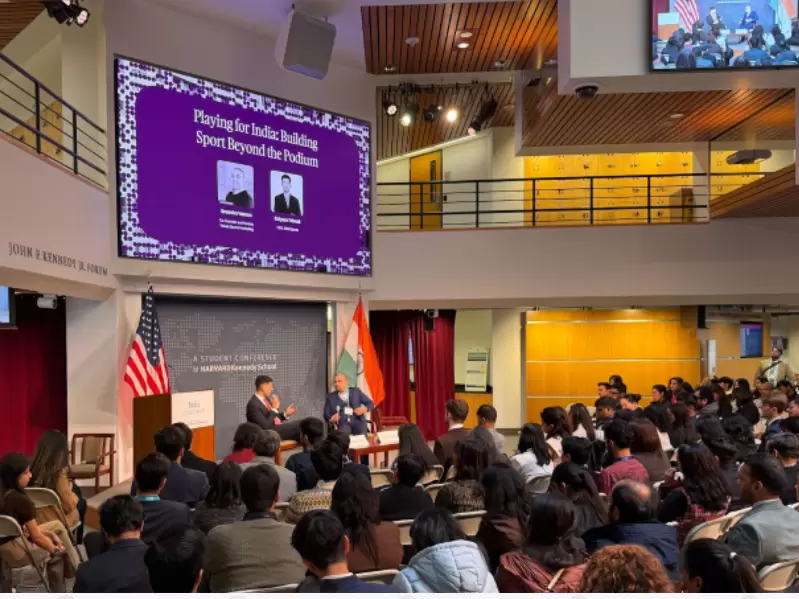 Satyam Trivedi, CEO of GMR Sports, at a panel at Harvard Kennedy School. / New India Abroad
India’s evolving role on the global stage took center stage this past weekend as the Harvard India Conference returned for its 2026 edition at Harvard University from Feb. 14–15. Centered on the theme “The India I Imagine,” the two-day conference brought together leaders from government, culture, business, technology and the Indian diaspora to discuss India’s ambitions, challenges and global influence.
Held across Harvard Kennedy School and Harvard Business School, the conference examined how India is navigating a defining decade, one shaped by rapid technological change, shifting global power dynamics and renewed debates around identity, inclusion and responsibility.
Day One of the annual Harvard India Conference opened at Harvard Kennedy School on Feb. 14, with conversations that examined India’s growth beyond traditional economic metrics, beginning with a panel on building sport beyond the podium, positioning athletics as a form of national infrastructure rather than spectacle.
ALSO READ: Tharoor hails Priyanka Chopra for 'making India proud'
Satyam Trivedi, CEO of GMR Sports, argued that India’s sporting ambitions must be rooted in long-term systems rather than short-term wins. He also pointed to a broader cultural shift among young Indians, noting that increased health consciousness is driving participation in everyday sports and fitness activities beyond professional competition.
Trivedi highlighted the growing popularity of sports such as pickleball and paddle, along with increased health-forward activities like running and CrossFit becoming part of everyday lifestyles for many young Indians, linking this rise to changing lifestyle priorities around wellness and preventive health.
“Today India is truly a multi-sports destination and there is a lot happening. Coming 30 years is India’s story in sports,” Trivedi said, adding that this shift presents an opportunity to build sustainable sporting ecosystems that support both grassroots participation and elite performance.
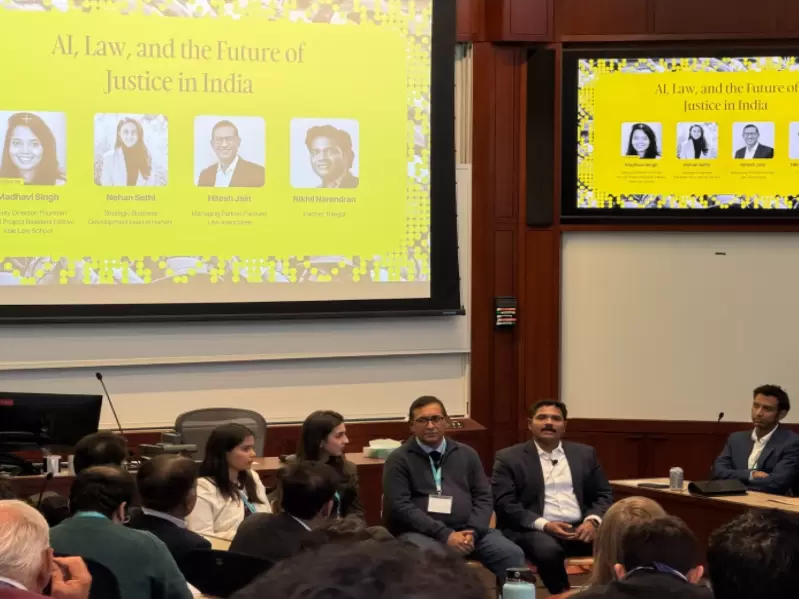 AI, Law, and the Future of Justice in India panel at Harvard Kennedy School / New India Abroad
From sport, the conversation moved into governance and technology in a panel titled “AI, Law, and the Future of Justice in India.” Legal professionals and technology leaders discussed how artificial intelligence is already reshaping legal practice, while underscoring the need for thoughtful regulation.
Hitesh Jain, managing partner at Parinam Law Associates, spoke about how AI tools are helping lawyers streamline research, documentation, transcription and case preparation, allowing more time for strategic and client-facing work.
“AI is being used to reduce friction in the judicial sector. I’m talking about delays and backlogs that are pending in the courts. I think the purpose of AI, when it comes to the judiciary, is that it should help the institution remember better, explain better and prioritize better,” Jain said, emphasizing that AI is augmenting, not replacing, legal expertise.
ALSO READ: Desi girls at Harvard
At the same time, the discussion emphasized that legal frameworks must evolve to address new risks emerging from AI adoption. Panelists pointed to issues such as deepfakes, digital impersonation and misinformation, noting that lawmakers and legal institutions are increasingly focused on countering these threats through regulation and accountability mechanisms.
The panel also included representatives from Harvey, an AI platform supporting law firms globally. Nehan Sethi, strategic business development lead at Harvey, spoke about how AI is increasingly being embedded into legal workflows, improving speed, consistency and access to legal information at scale.
“I think we have now reached a place where, instead of folks asking whether AI can work or do the work, we are now at a stage where we are building workflows end to end that can really help lawyers do their work better,” Sethi said.
Environmental governance formed another pillar of the day’s policy discussions. In a panel focused on climate-forward development, S.K. Jha, a senior member of the World Bank Group, spoke about the challenge of aligning climate ambition with inclusive growth in a country as complex as India.
The tone then shifted from systems to society. In a panel on young men, masculinity and mental health, speakers examined the emotional consequences of economic pressure and social expectation. Mental health advocate Nikhil Taneja, co-founder of Yuvaa, called for emotional infrastructure to be treated as seriously as economic infrastructure.
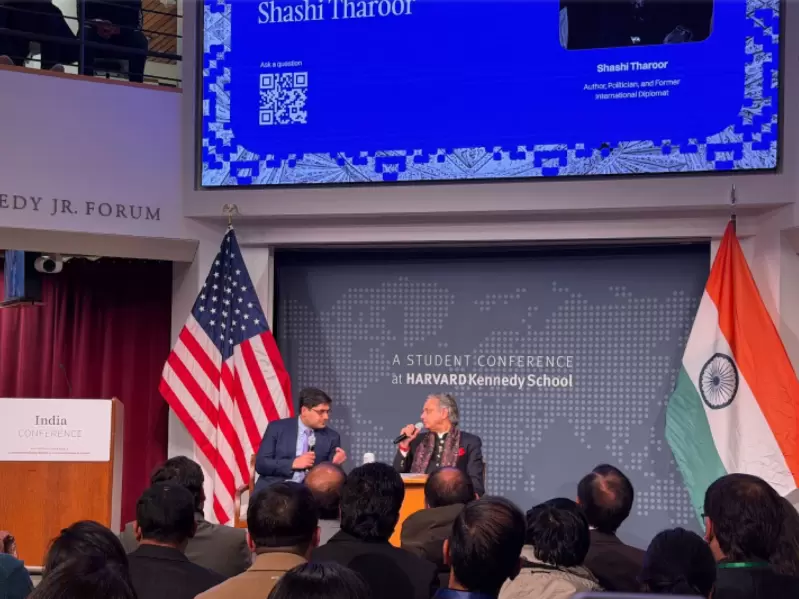 Keynote address by Shashi Tharoor at Harvard Kennedy School / New India Abroad
The day concluded with a keynote address by Shashi Tharoor, who reflected on India’s global standing at a time of heightened visibility and scrutiny, urging audiences to consider how democratic values and institutional integrity shape the country’s international credibility. Returning to the conference’s central theme, “The India I Imagine,” Tharoor framed the idea of imagining India not merely as aspiration, but as a responsibility grounded in constitutional values.
“To imagine India today, therefore, is to recommit to constitutional morality, a phrase resurrected by Ambedkar in Draft Two of the Constitution—not as a slogan to be invoked, but as a practice to be lived. For a nation that forgets how to argue within rules eventually forgets why those rules exist at all,” Tharoor said.
Day Two of the annual Harvard India Conference moved to Harvard Business School on Feb. 15, where discussions shifted toward markets, entrepreneurship, technology and the systems shaping India’s next phase of economic growth.
Entrepreneurship set the tone for the day, with discussions highlighting India’s next phase of growth. In the Trailblazers at ICH session, Ananya Birla spoke about building and scaling ventures independently while also pursuing a creative career as an artist. Her remarks reflected a broader shift in India’s startup ecosystem, where entrepreneurship is increasingly shaped by experimentation, cross-disciplinary thinking and a willingness to challenge inherited expectations.
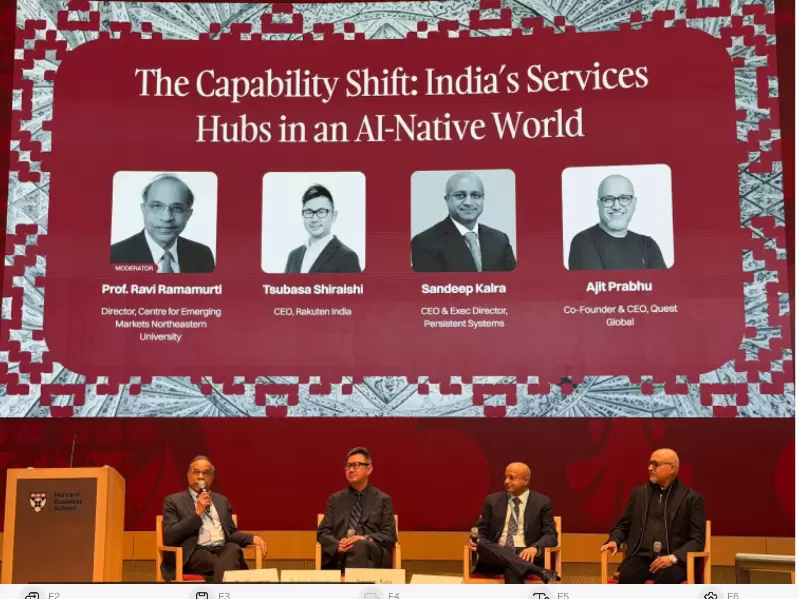 Speakers at an AI panel at Harvard Business School / New India Abroad
As the day progressed, the focus moved decisively toward artificial intelligence, which emerged as a central pillar of India’s growth strategy. AI was the dominant theme across multiple panels, reflecting both urgency and ambition around India’s position in the global AI ecosystem. Speakers emphasized that AI innovation in India is no longer theoretical, but actively being deployed across enterprises, startups and global platforms.
ALSO READ: Harvard students to organize annual India conference
In panels like “In the Right to Win: Where Does India’s AI Opportunity Lie?”, investors and founders discussed India’s strategic position in the global AI ecosystem and where the country can build sustainable competitive advantage. This was followed by “The Capability Shift: India’s Services Hubs in an AI-Native World,” a panel featuring leaders from leading companies, including Rakuten India, which examined how enterprises are adapting their services and operating models as AI becomes central to scale, efficiency and innovation.
Beyond technology, Day Two also explored how culture and commerce intersect in India’s global expansion. A panel titled “Flavour Intact: India’s Home Kitchens at the Global Table,” examined how home-style cooking traditions are being scaled into multi-city and international restaurant concepts without losing authenticity.
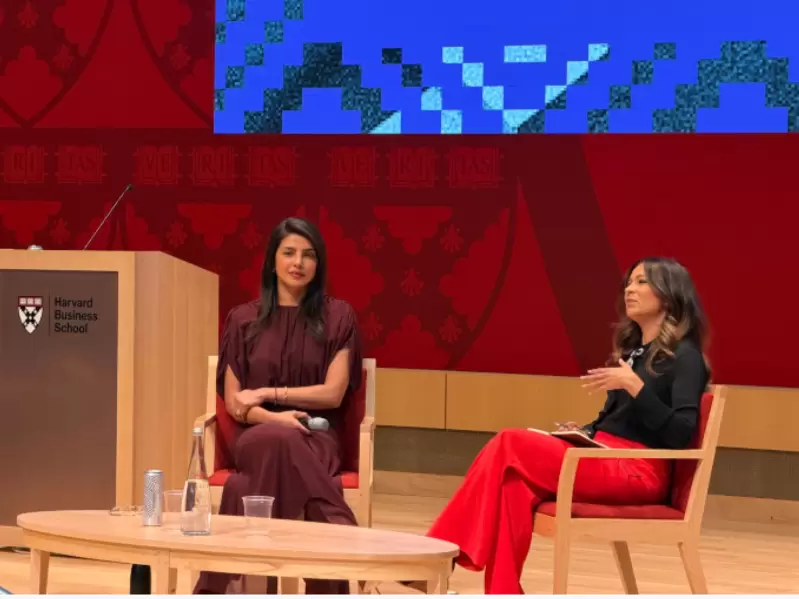 Priyanka Chopra Jonas with Anjula Acharia for a fireside chat at Harvard Business School / New India Abroad
The conference concluded with a fireside conversation featuring Priyanka Chopra Jonas, who reflected on identity, global visibility and the confidence with which India now occupies international spaces. Speaking about the India she imagines, Chopra said,
“It’s not about surviving anymore, we are thriving. And you all make that happen, your conviction in yourself and being proud of where you come from.”
Following her remarks, the conference closed with a soulful performance by Sid Sriram, whose renditions of songs from popular South Indian films and a stirring “Vande Mataram” left the audience enamored, bringing the two-day gathering to a resonant and emotional close.
Discover more stories on NewIndiaAbroad
Leave A Comment
Related








ADVERTISEMENT

ADVERTISEMENT
E Paper
Video

Comments
Start the conversation
Become a member of New India Abroad to start commenting.
Sign Up Now
Already have an account? Login