ADVERTISEMENT
ADVERTISEMENT



As ICE presence intensifies, Minnesota adopts Chicago’s community defense playbook
Speakers said immigration enforcement has had a chilling effect on daily life.
-
 Ritu Marwah
 - Sat, 31, Jan 2026
- 03:21 EST
- 119
 File photo / Reuters
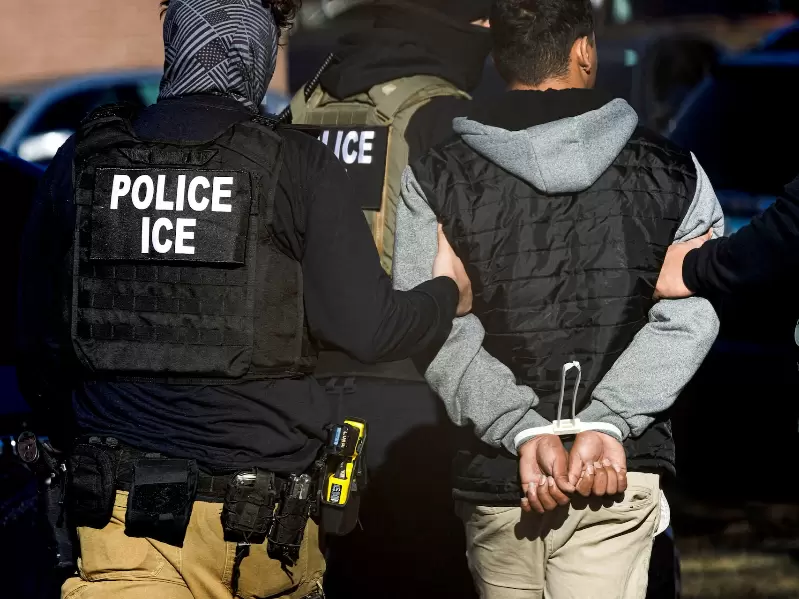
As federal immigration enforcement reaches unprecedented levels in Minnesota, community organizations across the state are drawing directly from Chicago’s experience to organize neighborhood defense, protect schools, and sustain families living in fear of arrest.
Advocates speaking at a recent American Community Media briefing described how Minnesota’s response to a historic ICE deployment — nearly 3,000 agents operating in and around Minneapolis — has been shaped by organizing models first developed in Chicago during earlier large-scale enforcement operations.
“What we’re seeing right now is horrific,” said Amanda Otero, co-executive director of TakeAction MN, pointing to federal agents deploying tear gas near schools, arresting legal observers, and conducting operations in residential neighborhoods. “And at the same time, I’ve never been more proud to be a Minnesotan.”
Community response amid escalating enforcement
Speakers said immigration enforcement has had a chilling effect on daily life. Families across documentation statuses are staying home from work, school, and grocery stores, fearing detention. Schools, in particular, have become flashpoints.
Otero recounted witnessing federal agents tear-gassing people near her child’s preschool just one day before the killing of Renee Goode, a Minneapolis parent and community member. The following day, she said, federal agents again deployed tear gas and made arrests on public school grounds.
“These are not one-off images,” Otero said. “This is happening on every block, every day.”
In response, Minnesota communities have mobilized at scale. Tens of thousands of residents are participating in ICE watch patrols, escorting children to and from schools, delivering groceries, providing rides, and raising funds to help families cover rent and utilities.
Sanctuary schools modeled on Chicago
Central to Minnesota’s strategy is the development of sanctuary school teams, an organizing model explicitly adapted from Chicago.
“We built our sanctuary school teams off the model in Chicago,” Otero said.
In Minneapolis alone, more than 1,000 parents and caregivers have organized sanctuary teams at 40 public school sites, with trainings now expanding statewide. The teams operate around three pillars: monitoring and deterring ICE activity near schools, coordinating mutual aid for families afraid to leave their homes, and organizing politically to demand ICE’s removal from schools and from Minnesota.
The approach mirrors strategies honed in Chicago during Operation Midway Blitz, a multimonth enforcement surge that involved dozens of ICE agents.
Chicago’s blueprint: Education, defense, mutual aid
Seri Lee, deputy organizing director at ONE Northside, a Chicago-based organization, described how the city responded to ICE surges through layered, neighborhood-based organizing.
“When ICE came into Chicago, one thing people noticed was that everyone seemed to know their rights,” Lee said.
Chicago groups focused heavily on “Know Your Rights” education, training residents to identify ICE agents, refuse entry without judicial warrants, document enforcement activity, and access legal and material support. Organizers established block-by-block networks, centralized hotlines, and rapid-response systems that enabled thousands of residents to act collectively.
The result, Lee said, was an unprecedented level of coordination. In one case, after a daycare worker was detained while reporting to work, hundreds of neighbors mobilized the same night to demand her release. She was freed shortly thereafter.
Mutual aid was equally critical. Volunteers organized grocery deliveries, rides, rent assistance, child care support, and even dog walking for families sheltering in place.
“That work is still ongoing,” Lee said.
From defense to political pressure
Chicago organizers eventually moved from defensive strategies to offensive political organizing, training hundreds in nonviolent resistance and targeting corporations with contracts tied to ICE and the Department of Homeland Security.
Actions were staged at dozens of AT&T locations across Illinois, aiming to impose economic and reputational costs on companies seen as enabling enforcement operations. The organizing has since translated into legislative efforts, with Chicago elected officials introducing proposals to divest city contracts from ICE-linked entities.
That evolution has not gone unnoticed in Minnesota.
“We learned a lot from Chicago,” Otero said, noting ongoing organizer-to-organizer trainings and collaboration. In Minneapolis, she said, some elected officials have joined school patrols and shown up during enforcement actions, signaling a growing alignment between grassroots organizers and local government.
An unprecedented scale in Minnesota
Despite these lessons, speakers emphasized that Minnesota is confronting enforcement at a scale Chicago has not yet experienced. Vanessa Cárdenas, a national immigration policy analyst, said the Minneapolis deployment represents the largest ICE presence ever recorded in a U.S. city.
“They started with 2,000 agents and added another 1,000,” Cárdenas said. “We expect more of the same.”
Polling data, she added, suggests a growing majority of Americans believe ICE has gone too far, including a majority of independents. Still, she cautioned that public opposition to enforcement does not automatically translate into support for comprehensive immigration reform.
A movement expanding under pressure
Even as enforcement intensifies, organizers described a moment of rapid political awakening.
“In the last five years, I have never seen this many people get off the sidelines,” Otero said. “This moment is pushing people, whether they supported ICE before or not, to act.”
Chicago’s experience, speakers said, offers both a warning and a roadmap: Large-scale enforcement can fracture communities, but it can also catalyze durable, disciplined organizing rooted in nonviolence, mutual aid, and collective defense.
As Minnesota faces an uncertain path ahead, advocates say those lessons may prove essential.
Discover more stories on NewIndiaAbroad
Leave A Comment
Related








.png)
ADVERTISEMENT

ADVERTISEMENT
E Paper
Video

Comments
Start the conversation
Become a member of New India Abroad to start commenting.
Sign Up Now
Already have an account? Login