ADVERTISEMENT

ADVERTISEMENT



Deadly distraction: Texting behind the wheel — A ‘killer’ on U.S. roads
Federal crash statistics show that distracted driving was a factor in about eight percent of all fatal crashes nationwide in recent years.
-
1750365196.png) Maneesh Pandeya
Maneesh Pandeya - Tue, 03, Mar 2026
- 12:41 EST
- 14
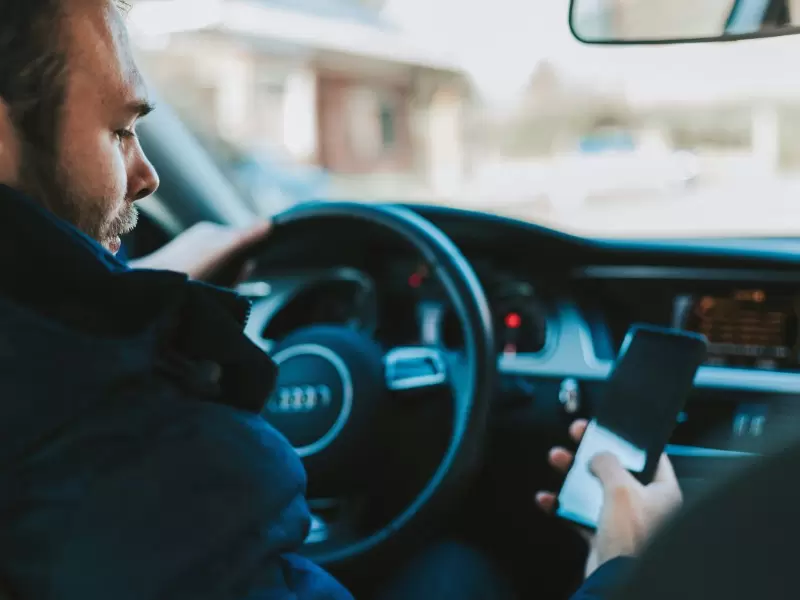 Representative image / Courtesy: Unsplash
Texting while driving has quietly become one of the deadliest and most preventable threats on American roads, claiming thousands of lives every year despite near-universal awareness of its dangers.
New research and national crash data in a peer-reviewed journal article show that the habit of checking messages behind the wheel continues to fuel fatal crashes, serious injuries, and lasting trauma for families and communities.
“Texting while driving is not just risky behavior—it is a public health crisis hiding in plain sight,” said Dr. (Prof.) Manoj Sharma, a public health expert and globally published scholar of community health. “The science is clear. When drivers look at their phones, even briefly, the risk of a crash rises dramatically. These deaths are not accidents; they are preventable,” says Dr. Sharma, citing the multi-author research study.
ALSO READ: Model minority myth masks rising heart risks in South Asian Americans, physician says
According to national safety estimates, distracted driving contributes to approximately 1.6 million crashes every year in the United States. At any given daylight moment, about 660,000 drivers are actively using their phones while driving. Between 2011 and 2021, cellphone use accounted for roughly 13 percent of all fatal crashes involving driver distraction, underscoring the deadly role mobile phones continue to play on U.S. highways.
Federal crash statistics show that distracted driving was a factor in about eight percent of all fatal crashes nationwide in recent years. When mobile phones were specifically identified, they contributed to nearly 12 percent of distraction-related deaths. Safety experts caution that these numbers likely underestimate the real toll, as phone use is often difficult to confirm after a crash and may go unreported in police investigations.
Texting while driving is especially dangerous because it combines three forms of distraction at once—visual, manual, and cognitive. Drivers who text take their eyes off the road for an average of five seconds. At 55 miles per hour, that is equivalent to driving the length of a football field without looking.
“Reaction times while texting can be worse than those of intoxicated drivers,” Dr. Sharma explained. “Drivers may believe they are in control, but the brain simply cannot process driving and digital communication at the same time.”
Young drivers face the highest risks. Surveys indicate that nearly four in ten high school students admit to texting or emailing while driving. Among drivers aged 15 to 20 involved in fatal crashes, distraction accounts for the highest proportion compared to other age groups. College-age drivers, researchers note, often underestimate the danger because of habitual phone use and a false sense of multitasking ability.
The peer-reviewed study led by Dr. Sharma examined texting while driving among college students and found alarmingly high rates of engagement despite awareness of the risks. Besides Dr. Sharma, other authors contributing to the research are Sidath Kapukotuwa, Sharmistha Roy, Mahsa Pashaeimeykola, and Asma Awan. The multi-author research identified behavioral confidence—the belief that one can resist checking the phone—as the strongest factor in stopping the behavior. Emotional control and deliberate practice were key to sustaining safer driving habits.
“Awareness alone is not enough,” Dr. Sharma said. “We have spent years telling people texting is dangerous. What works is helping drivers build confidence, manage impulses, and change routines—such as putting the phone out of reach or using driving-mode technology.”
The human cost of distracted driving extends far beyond drivers themselves. Hundreds of thousands of people are injured each year, including pedestrians, cyclists, and passengers. Families face lifelong consequences—from disability and lost income to emotional trauma—often triggered by a single text message.
All 50 states and the District of Columbia now ban texting while driving, and most states prohibit handheld phone use. Yet enforcement remains uneven, and public health experts say laws alone cannot solve the problem.
“Laws establish boundaries, but culture determines behavior,” Dr. Sharma noted. “Just as society reshaped attitudes toward drunk driving, we must reach a point where texting behind the wheel is socially unacceptable.” Safety advocates urge drivers to take immediate steps: activate ‘Do Not Disturb While Driving’ settings, silence notifications, plan communication breaks before trips, and model safe behavior for young drivers.
The message from researchers and safety officials is unequivocal. No message, notification, or social media update is worth a life. Ending texting while driving, experts say, is one of the simplest and most powerful actions Americans can take to make roads safer for everyone.
Maneesh Pandeya is a Fulbright Professor and Ph.D. Scholar at Howard University in Washington, DC.
Discover more at New India Abroad.
Related










ADVERTISEMENT

ADVERTISEMENT
E Paper
Video

Comments
Start the conversation
Become a member of New India Abroad to start commenting.
Sign Up Now
Already have an account? Login