ADVERTISEMENT

ADVERTISEMENT

Meet Neil Nayyar, master of 140 instruments

From Indian classical music to film scoring and hybrid DJ sets, the California-based musician talks Breaking Barriers, touring with Ali Zafar, and why heritage is a launchpad, not a limitation.

 Neil Nayyar Neil Nayyar / Courtesy photo

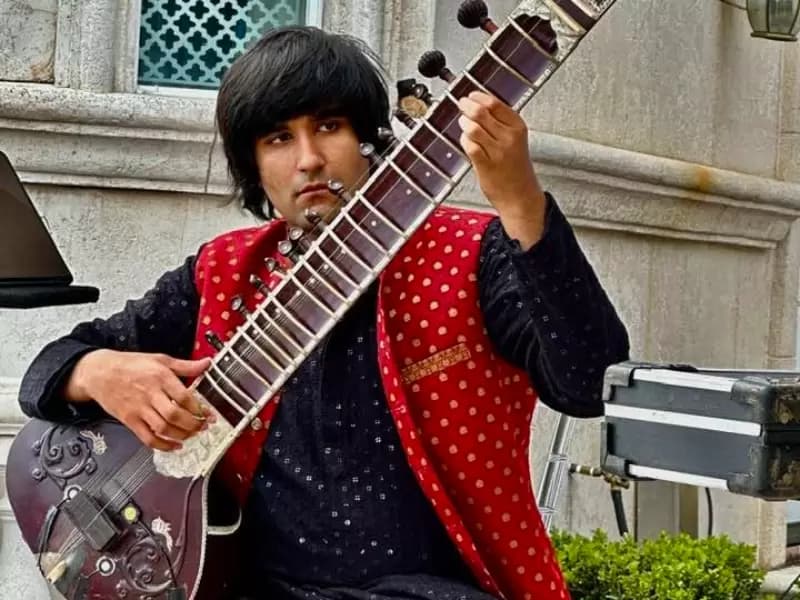
To look at Neil Nayyar’s instrument collection is to look at a map of human history. The California-based multi-instrumentalist, composer, author, and actor has mastered over 140 instruments, performs fluently in 11 languages, and holds world records that have landed him on Good Morning America and The Jennifer Hudson Show. Yet, to define Neil by a mere number is to miss the soul of his artistry. 

Rooted firmly in the rigorous, meditative traditions of Indian classical music, specifically the sitar, tabla, and tanpura, Neil has built a permanent internal compass that allows him to navigate jazz, cinematic scoring, and electronic production without ever losing his identity.

Fresh off the release of his debut album Breaking Barriers and his book Passion to Exploration of 107 Sound Machines, Neil is a whirlwind of creative energy. New India Abroad sat down with Neil to discuss his fluid approach to daily practice, the spiritual significance of his Indian roots, and his advice for the next generation of diaspora artists pursuing non-traditional paths. Here are highlights of the interview: 

Your musical journey was sparked before birth by your parents playing classical music. How did that early foundation shape your rare aptitude for instruments?

Neil Nayyar: I often joke that my musical journey began in the womb, where my parents regularly played Mozart to spark my musical growth. Growing up, I interacted with sounds the same way other kids played with toys, with pure, boundaryless curiosity rather than rigid lessons. As that playground expanded, I became fascinated by how instruments from completely different cultures could speak the exact same emotional language. Today, whether I'm scoring a film or spinning a hybrid DJ set, it’s always about how deeply sound can connect us to the human experience. 

Neil Nayyar / Courtesy photo

You perform in 11 languages and span genres from Indian Classical to jazz. How does your Indian heritage anchor you while navigating so many global styles?

Neil Nayyar: My training in Indian classical music gave me a permanent internal compass for rhythm, depth, and improvisation that I carry into every single genre I explore. When I dive into jazz, electronic music, or perform in 11 different languages, it never feels like I'm switching identities, I’m just using a different vocabulary to tell the same emotional story. My Indian roots don't box me in; they give me the solid ground and confidence I need to push global boundaries without ever losing sight of who I am. 

Out of the 140+ instruments you play, which Indian classical instruments hold the deepest personal or spiritual significance for You?

Neil Nayyar: Indian classical instruments hold a deeply spiritual space for me because they are closest to my skin. The sitar allows me to explore microtones that mirror the human voice, the tabla serves as a masterclass in treating rhythm as a living pulse, and the hypnotic drone of the tanpura acts as my meditative reset button. These tools belong to a tradition of inner awareness, a philosophy I carry with me every time I approach any of the 140+ instruments in my collection to look for its soul rather than just its notes. 

What does your daily practice routine look like to keep your skills sharp across so many different families of strings, winds, and Percussion?

Neil Nayyar: Instead of a rigid routine, my practice relies on rotating between instrument families, like strings, winds, and percussion, to maintain an intuitive touch across different setups. I spend a lot of time on sound exploration, ear training, and recreating live scenarios like looping and layering to simulate real-world performances. Ultimately, my practice isn't just about keeping skills sharp; it's about staying adaptable so that all 140+ instruments can inform each other rather than existing in separate worlds. 

Your debut album is titled Breaking Barriers. What specific cultural or musical barriers were you most passionate about tearing down?

Neil Nayyar: The title Breaking Barriers reflects my philosophy that music should never exist within strict cultural, stylistic, or technical boxes. With this album, I wanted to challenge those separations by naturally blending Indian classical instruments with cinematic scoring, jazz improvisation, and electronic production. It’s about breaking down the internal fear of experimentation and proving that an artist can seamlessly span multiple identities and traditions. 

What inspired you to write your book, Passion to Exploration of 107 Sound Machines, and why is expanding the musical vocabulary of the next generation so important to you?

Neil Nayyar: The inspiration for Passion to Exploration of 107 Sound Machines came from the lack of a clear roadmap for anyone wanting to move across multiple musical worlds and cultures. The book focuses on the mindset of how curiosity can become a structured path, showing that you don't have to limit yourself to just one identity. My goal is to empower the next generation to connect global sounds meaningfully and create without boundaries. 

Neil Nayyar touring with Ali Zafar / Courtesy photo

What was it like touring with international superstar Ali Zafar, and how do you approach blending your sound with other major artists?

Neil Nayyar: Touring with Ali Zafar was incredibly inspiring, especially watching how naturally he blends genres to connect with audiences across cultures. My approach to collaborating with major artists is always to listen first, studying the emotional arc of their songs to find where my live instruments can enhance the experience without overpowering it. Collaboration is about respect for the music; when that foundation is there, blending our sounds becomes a natural conversation rather than a technical exercise. 

From The Jennifer Hudson Show to jamming on Let’s Make a Deal, how do you use mainstream television platforms to advocate for world music?

Neil Nayyar: Mainstream television platforms like The Jennifer Hudson Show and Let’s Make a Deal are powerful bridges that allow world instruments to reach a massive, everyday audience. My approach is to present traditional sounds in a contemporary, accessible way—often through modern production or hybrid setups—so viewers can see these instruments belong in today’s musical landscape. It’s less about showcasing technique and more about sparking a viewer's curiosity to explore new cultures and global sounds. 

As a film composer, how does having a palette of 140 instruments change how you approach storytelling and creating emotion for a movie score?

Neil Nayyar: Having a palette of over 140 instruments completely redefines how I approach film scoring, allowing me to choose specific emotional textures and cultural colors rather than standard orchestral sounds. I think in terms of emotional layers, using one instrument to carry the tension while another weaves a vulnerable, human thread on top of it. I never use an instrument just for novelty; every sound choice must serve the emotional truth and intentional language of the story. 

With the massive surge in South Asian creative representation globally, what advice do you have for young diaspora artists pursuing non-traditional paths?

Neil Nayyar: My biggest advice to young diaspora artists is to view your heritage as a foundation rather than a limitation, refusing to fit into predefined boxes of what success should look like. When pursuing a non-traditional path, focus entirely on consistency and discipline over immediate validation, especially when blending disciplines or creating something entirely new. Most importantly, don’t wait for permission, stay curious, embrace a multidisciplinary mindset, and trust that if you stay authentic, your work will find its place. 

What is the next frontier for you, is there a 141st instrument you have your eye on, or a dream collaboration you’re chasing?

Neil Nayyar: For me, the next frontier isn't about hitting a specific number of instruments, but continuously asking what new emotional or sonic world I can enter next. I'm deeply focused on the future of live performance, especially the space where technology, live instrumentation, and storytelling merge in my hybrid DJ sets. My goal is to keep evolving through creative, cross-genre collaborations and lifelong discovery, the moment I feel like I've fully defined my sound is the moment I know I need to change it. 

Anything else you would like our readers to know?

Neil Nayyar: Art has no borders, a philosophy that has opened doors from releasing my debut album to showcasing the Indian sitar across California and beyond at Got Milk? Billboard campaign for 30th Anniversary of The Milk Mustache. This upcoming season takes that to a new level, starting with the US National Anthem at the Sacramento River Cats game on July 9th, followed by the California State Fair at Cal Expo on July 31st, touring with Ali Zafar on August 14th in Houston and August 15th in Sacramento, and bringing my hybrid DJ set to the Anime Expo in Elk Grove on October 18th. 

Behind the scenes, my film work is in overdrive as I sound-design a SAG short film, score two feature films and several shorts in post-production, and step in front of the camera as 'Void Walker' in the indie feature Resurrection: In The Field Of Blood, directed by Glenn Spillman under Cellar 13 Films. Whether performing with a global icon, spinning an electronic set, scoring, or acting, it’s all about pushing the boundaries of storytelling. 

Discover more at New India Abroad.

Comments

Leave A Comment

Required fields are marked (*).

Related