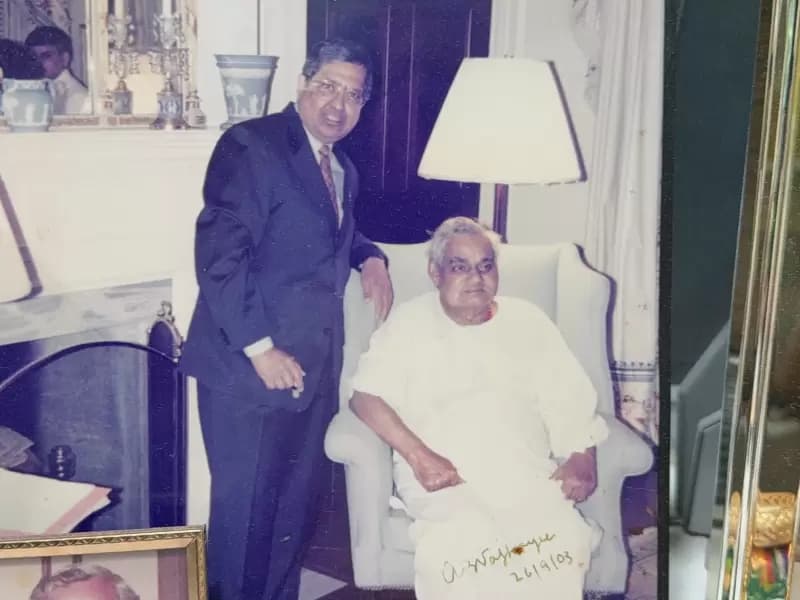
Dr. Suresh C. Gupta reflects on nearly six decades of the Indian American community's growth in the United States. / Special Correspondent
When Dr Suresh C. Gupta arrived in Worcester, Massachusetts, in the summer of 1967, the United States offered the medical training he wanted. It offered considerably less by way of food he could eat.
Gupta was one of about a dozen Indian doctors at City Hospital. They were called house physicians in India and residents in America. All were vegetarians. Indian restaurants were nowhere nearby. There was no car and little money to spare.
Also read: New architects of innovation: Indian-American women disrupting tech, finance, and health
“My breakfast, lunch, dinner. Every day was the same. No change,” Gupta recalled. “So those were the days when we had rough time, same meals, breakfast, lunch and dinner.”
The young doctors earned about $300 a month. Boston, reachable by bus, was the nearest large city. Yet even there, Gupta said, familiar ingredients were difficult to find.
A year later, after moving to Washington and getting married, he and his wife would drive to New York for Indian groceries. A Spanish shop stocked some spices, lentils and rice. Flour presented another problem.
“The atta used to be Pillsbury whole grain atta, which nobody liked, but we had no choice,” he said. “So those was tough times.”
Those recollections belong to an Indian American experience that can be difficult to recognise today. Indian restaurants and grocery stores now dot the Washington suburbs. Temples, cultural associations and professional organisations have become established institutions. Indian Americans lead companies, serve in government and raise money for political candidates.
Gupta has watched that transformation from unusually close quarters—as a physician, temple organiser, political participant and host to generations of Indian and American public figures.
“India has, or Indian Americans in this country has progressed beyond imagination,” he said. “We could not imagine that we will be the most sought after entrepreneurs in this country.”
His account is the journey of an AIIMS-trained doctor seeking an advanced degree, and the larger story of a diaspora learning to build institutions and exercise influence.
Gupta was born in Delhi in 1942 and raised near Filmistan Cinema. He graduated from the All India Institute of Medical Sciences in 1964, completed an internship there and worked as a resident house physician in internal medicine.
He left India at 23, initially for England. His objective was postgraduate training and the Membership of the Royal Colleges of Physicians qualification. But after about a year, he concluded that England would not provide the opportunity he was seeking.
“So I left England and came to US hoping that I will be able to get the education and postgraduate training that I so much wanted,” he said.
He landed in Worcester on June 30, 1967. In July 1968, he moved to Washington for a residency at DC General Hospital. He later trained in pulmonary medicine through Georgetown University.
The Washington he entered was passing through one of its most turbulent periods.
Martin Luther King Jr. had been assassinated in April 1968. Robert F. Kennedy was killed two months later. Parts of Washington had been scarred by rioting and fire. The Vietnam War brought protests and a military presence to the capital.
Gupta, who lived in Virginia and travelled across Key Bridge to Georgetown, remembered seeing National Guard personnel stationed along his route.
“I had to drive past those to go to Georgetown because my hospital was only about a few miles from where I lived,” he said. “So this lot has changed.”
The city’s physical landscape was different. The Capital Beltway was under construction. Major roads were less developed. The Indian community was small and loosely connected.
“If I recall, there are no more than thousand Indian families in Washington DC,” Gupta said.
Encounters between Indians could quickly become social occasions. Passengers travelling to India on Air India flights talked until they discovered a mutual acquaintance. Hindi films were sometimes screened at Catholic University, where families arrived dressed for the occasion. The reels had to be shown and rewound one at a time.
There were no temples, Gupta recalled, and limited opportunities for children to learn Hindi or participate in Indian festivals.
“Before that, the interaction between the Indian Embassy and the diaspora was minimal,” he said.
Gupta said he did not experience hate crimes during his early years in America. But he encountered stereotypes about a country many Americans understood through images of snake charmers, wandering cattle and poverty.
“And sometimes people would ask us, ‘Do you have ice cream in India?’” he said.
The more consequential discrimination came when he began seeking work.
In 1972, after completing his fellowship, Gupta applied for a pulmonary physician’s position at a hospital in Prince George’s County. The hospital, he said, continued advertising the vacancy but did not interview him.
“I would have been the only board certified pulmonary physician in that hospital at that time,” he said. “They would not interview me because they are waiting for their own kind to be interviewed and offered the job.”
He paused over the memory.
“So that was a time that I did see discrimination.”
Gupta established a solo internal and pulmonary medicine practice in 1973. It continued until March 2020.
His career eventually carried him into positions that would have appeared improbable when he arrived. He became president of the Prince George’s County Medical Society in 1991. He served on Maryland’s physician licensing board and chaired the Maryland Board of Physician Quality Assurance. The Maryland House of Delegates and Senate honoured his public service through unanimous resolutions.
“I’ve been blessed and did everything that, you know, I could have achieved,” he said.
Medicine was only one part of Gupta’s American life.
As Indian immigrants established themselves professionally, he became involved in building the community’s cultural and political infrastructure. He was a founding trustee and president of the Hindu Temple of Metropolitan Washington and held several leadership positions at the Durga Temple in Fairfax Station, Virginia.
“Actually, I started Hindu Temple Organization in Washington DC,” he said. “Hindu Temple was born at my home. I signed the article of self-incorporation.”
He also created a Diwali Mela in the Washington metropolitan area in 1995. About 5,000 people attended the first celebration, he said. The event was intended not simply as a festival but as a statement of collective identity.
“And that was a time we though we’ll unite our community,” he said. “I put it at the unity and diversity.”
The contrast with his first years in America is sharp. Where Gupta once travelled hundreds of miles for groceries, he now sees Indian shops and restaurants every few miles. Where families once gathered in borrowed auditoriums, the Washington region now has numerous temples and cultural institutions.
Professional success also changed the community’s relationship with American politics.
“There was a time when we used to meet our governors and elected officials, local and be happy to have our pictures taken with them,” Gupta said. “Now when we raise funds, we tell them, this is what we demand.”
The transition—from seeking access to asserting interests—may be one of the clearest measures of the diaspora’s rise.
“This is who we are, this is, we have a right, we need to be recognized,” he said. “And they listen to us.”
Gupta’s home and public work brought him into contact with Indian prime ministers, ministers, diplomats and American elected officials.
He served on reception committees during visits by Prime Ministers Rajiv Gandhi and P.V. Narasimha Rao. He helped organise a diaspora event for Manmohan Singh. He was a panel physician for Atal Bihari Vajpayee and met Narendra Modi during Modi’s visits to the United States before he became prime minister.
“I first met Modiji when he was nobody actually,” Gupta said. “He used to visit US one time he was visiting my friend here in this, Maryland and we had lunch together, five or six people.”
Gupta remembered finding Modi “Impressive,” though he said he did not imagine that the visitor would one day lead India.
“I was impressed and never though that he would become the prime minister one day,” he said.
Such visits were different in the 1990s. Indian political figures sometimes stayed with local supporters, partly because India still faced foreign exchange constraints. Members of the diaspora acted as hosts, organisers and informal bridges between the two countries.
Gupta believes that role has evolved. Indian Americans are no longer merely reception committees for visiting leaders. They are stakeholders in American institutions and participants in the bilateral relationship.
“We have to get involved in the activities of Indo-US relations, promote them and make sure that India is not taken for granted and is respected the kind of respect that we deserve,” he said.
For all his pride in the community’s progress, Gupta is troubled by what he sees as its enduring weakness: internal division.
“One of the reasons is that we Indian Americans are divided,” he said. “We are not united.”
Language, region, religion and organisational rivalry can pull the community in different directions, he said. His answer is not to dismantle separate associations but to persuade them to stand together when their broader interests converge.
“We have our own organization. We have our own things,” he said. “I say, have your own organization, but let us at the same time support each other in their activities.”
For Gupta, unity need not always mean money or membership. It can mean appearing at another group’s event, offering public support or demonstrating that an attack on one part of the community concerns the whole.
“We may not support them financially, but we support them,” he said. “We are with you.”
He is also concerned about the distance between India and younger Indian Americans who have not spent significant time there. Gupta said he took his children to India regularly and has travelled there about 50 times. Other families, he said, have not always been able to provide that exposure.
He is now involved in plans for an India heritage centre in the Washington area. The proposed centre would use artefacts and educational material to introduce younger generations to Indian history and culture.
“Hopefully that will give them hope and they will think more about India for, in positive terms,” he said.
Nearly 60 years after his arrival, Gupta’s story spans two strikingly different versions of Indian America. The first had doctors who could not find vegetarian food and families who travelled long distances for lentils and flour. The second has business leaders, political donors, elected officials and an extensive network of temples and associations.
He still distributes a lapel pin bearing the Indian flag and a message of pride. He said he has given it to Vajpayee, Modi and visiting ministers.
But the identity expressed by that pin has changed with the community itself. It is no longer solely the identity of Indians living abroad. It is rooted in two countries and accompanied by obligations to both.
“Now we are not just proud Indians, but proud Indian Americans,” Gupta said.
“And we will get it,” he added, speaking of the respect he believes the community deserves. “Sooner or later we’ll get it.”
Discover more at New India Abroad.
ADVERTISEMENT
ADVERTISEMENT
Comments
Start the conversation
Become a member of New India Abroad to start commenting.
Sign Up Now
Already have an account? Login