ADVERTISEMENT
ADVERTISEMENT



US judge strikes down Trump’s H-1B fee
Sorokin rejected the administration's argument that broad presidential powers under immigration law allowed the fee to be imposed as a condition of entry into the United States.
-
 IANS
IANS - Tue, 09, Jun 2026
- 05:18 EDT
- 273
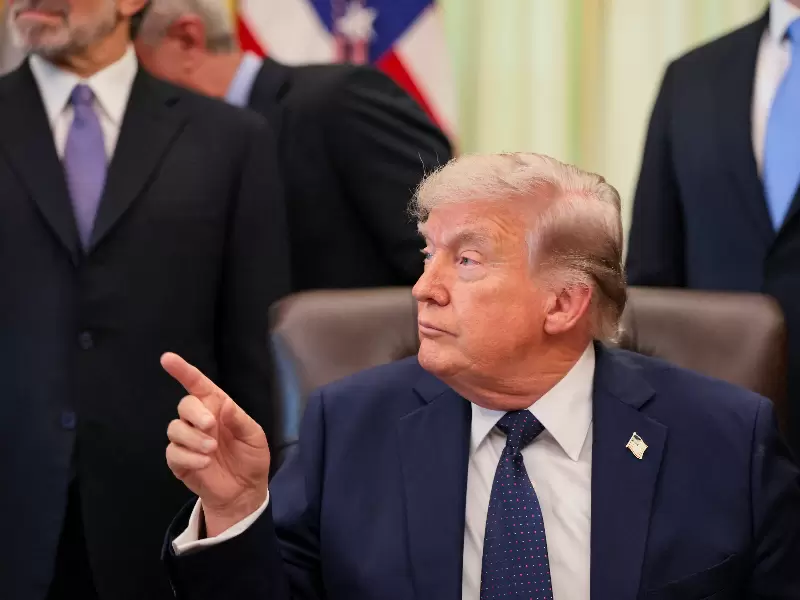 U.S. President Donald Trump points a finger as he participates in a healthcare affordability event in the Oval Office at the White House in Washington, D.C., U.S., April 23, 2026. / File Photo: REUTERS/Kylie Cooper
A federal judge struck down President Donald Trump's controversial $100,000 fee on new H-1B visa petitions, ruling that the administration exceeded its authority and imposed what amounted to an unlawful tax without approval from Congress.
In a major setback for the administration's immigration agenda, US District Judge Leo T. Sorokin of Massachusetts sided with a coalition of 20 states challenging the policy and vacated it nationwide.
“The Court finds that the Policy imposes a tax on H-1B petitions without the requisite delegation by Congress,” Sorokin wrote. “There are no statutory powers authorizing Defendants to implement a $100,000 tax on H-1B petitions.”
The ruling overturns a September 2025 presidential proclamation that required employers filing new H-1B petitions to make an additional $100,000 payment. The administration had argued that the H-1B programme was being exploited to replace American workers and suppress wages in key sectors, particularly science, technology, engineering and mathematics fields.
Also read: Gabbard resigns as Trump's top US intelligence official
The states contended that the measure would make it significantly more difficult for public schools, universities and healthcare systems to recruit skilled foreign professionals, worsening existing staffing shortages. The court agreed that the policy threatened to impede hiring in education, academic research and healthcare.
Sorokin rejected the administration's argument that broad presidential powers under immigration law allowed the fee to be imposed as a condition of entry into the United States.
“While the Executive has broad discretion over the admission and exclusion of aliens, . . . that discretion is not boundless,’” the judge wrote. He added that such discretion “may not transgress constitutional limitations” or “the statutory authority conferred by Congress.”
At the centre of the case was whether the fee was a legitimate immigration restriction or an unauthorised tax. Sorokin concluded it was the latter.
“Taxes are not ‘restrictions,’” he wrote while rejecting the government's interpretation of presidential powers under the Immigration and Nationality Act.
The judge said Congress had never delegated its taxing authority to the President through the immigration statutes cited by the administration.
“These considerations preclude reading INA §§ 212(f) and 215(a) as delegating Congress’s exclusive power to tax,” Sorokin wrote.
Beyond the constitutional issues, the court found that federal agencies violated the Administrative Procedure Act by implementing the policy without following the required notice-and-comment rulemaking process.
“Defendants issued a legislative rule without engaging in notice-and-commenting rulemaking,” the ruling said.
The court also found the policy arbitrary and capricious, saying agencies failed to adequately explain the unprecedented increase in costs imposed on employers.
“The administrative record is devoid of any indication that Defendants ‘reasonably considered the relevant issues and reasonably explained the decision’ to implement a $100,000 tax on H-1B petitions,” Sorokin wrote.
As a remedy, the judge declared the policy unlawful and vacated all agency actions implementing the payment requirement.
“The Policy implementing the Proclamation is declared unlawful and is VACATED in its entirety,” the ruling said.
The H-1B programme allows US employers to hire foreign professionals in speciality occupations requiring highly specialised knowledge and at least a bachelor's degree or equivalent.
Congress currently caps most new H-1B visas at 65,000 annually, with an additional 20,000 reserved for holders of advanced US degrees. Universities, affiliated non-profit institutions and certain research organisations are exempt from those annual limits.
Discover more at New India Abroad.
Related





ADVERTISEMENT

ADVERTISEMENT
E Paper
Video

Comments
Start the conversation
Become a member of New India Abroad to start commenting.
Sign Up Now
Already have an account? Login