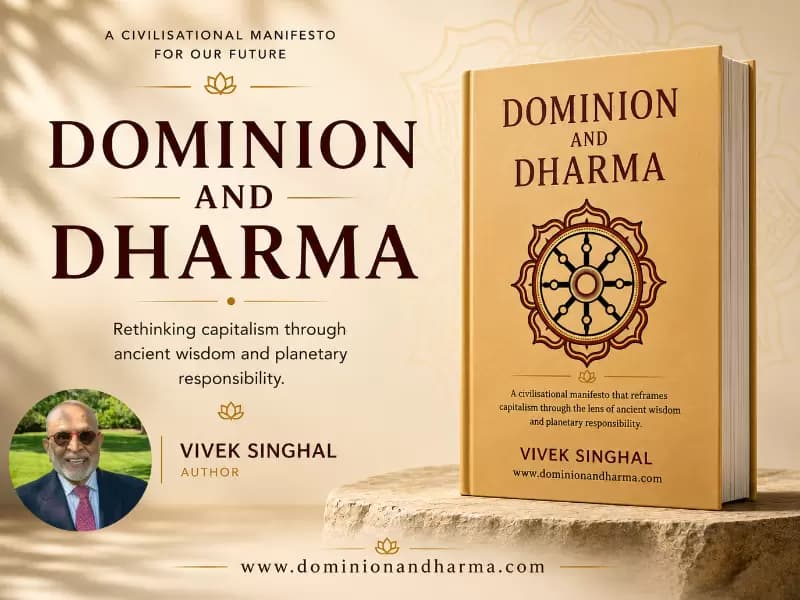
Dominion and Dharma book cover / Courtesy photo
In an era of deepening polarization — what a recent Washington Post opinion piece aptly termed the "God Gap," where religious and secular divides increasingly map onto partisan fault lines — humanity faces a profound crisis of decision-making.
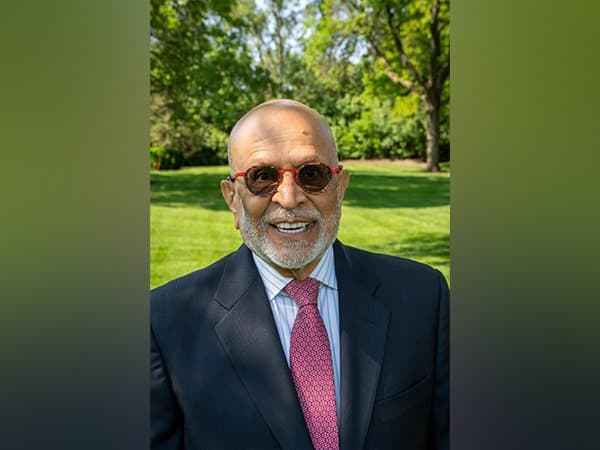
As the founder of the Dominion Dharma Destiny Identity Institute (DDDI) and author of 'Dominion and Dharma', I have long argued that such fractures are symptoms of a deeper civilizational malaise: the exhaustion of Dominion-mode thinking — extractive, binary and short-term — and the urgent need for a shift toward Dharma-aligned wisdom consciousness.
The accelerating Phygital Era, marked by AI, multiple intelligences and the fusion of physical and digital realities, amplifies both the risks and the opportunities. How do we navigate high-stakes choices amid uncertainty, technological disruption and meaning vacuums? Two ancient traditions offer complementary frameworks that speak directly to our moment: the Stoic philosophy of the Greco-Roman world and the timeless teachings of the Bhagavad Gita. Their synthesis points toward a practical Decision Dharma suited for the Indian diaspora and global civilizational evolution.
Stoicism, as articulated by Epictetus, Seneca and Marcus Aurelius, provides a rigorous decision-making protocol centered on the Dichotomy of Control. Some things are eph' hēmin — up to us: our judgments, desires, aversions and actions. Most externals — outcomes, reputations, geopolitical events, even the behavior of AI systems — are not.
This distinction is profoundly liberating. Before assenting to any impression or rushing into action, the Stoic pauses to ask: Is this within my power? Align the decision with the cardinal virtues — wisdom, justice, courage and temperance. Premeditate potential adversities (premeditatio malorum) to steel the mind. View the situation from a cosmic perspective, recognizing our place within a larger rational order (logos). Act with full commitment where possible, and accept with equanimity (amor fati) what is not.
In daily practice, this manifests through evening reviews and morning intentions — disciplined reflection that builds resilience. For leaders, entrepreneurs and diaspora professionals navigating volatile markets, AI-driven disruptions or cross-cultural tensions, Stoicism offers a powerful antidote to anxiety and reactivity. It trains us to focus energy on what truly depends on our moral will (prohairesis), rather than dissipating it in futile resistance to the uncontrollable.
The Bhagavad Gita presents a parallel yet deeper vision through Arjuna's battlefield crisis — a quintessential decision paralysis involving clashing duties, emotional overwhelm and fear of consequences. Krishna's guidance transcends simple rules, offering an integral synthesis of paths: Karma Yoga (selfless action), Jnana Yoga (discernment and knowledge of the eternal Self) and Bhakti Yoga (devotional surrender).
Key principles include svadharma (one's contextual righteous duty aligned with innate nature), nishkama karma (action without attachment to fruits — strikingly resonant with Stoic indifference to externals) and samatvam (equanimity in success and failure, declared as yoga itself). The Gita culminates in the call to abandon all lesser dharmas and take refuge in the Divine, acting as a conscious instrument of higher evolutionary will.
Sri Aurobindo, in his Essays on the Gita, reads this as an invitation to the divine life — not mechanical duty, but conscious participation in cosmic evolution. This is Decision Dharma at its fullest: holistic, consciousness-expanding and oriented toward loka-sangraha (the welfare of the world).
The complementarities are striking. Both traditions prioritize process and character over results, cultivate equanimity amid duality and demand alignment with a larger order — whether Stoic logos or Dharmic ṛta. Yet the Gita adds devotional depth and an evolutionary dimension that Stoicism, in its more immanent rationalism, sometimes leaves implicit.
Together, they form a potent hybrid for our times. Stoic rational clarity sharpens discernment amid information overload and AI-generated noise. The Gita's integral approach infuses it with heart, surrender and civilizational memory — essential for bridging the very divides the "God Gap" exposes. For the Indian diaspora, this synthesis is particularly potent. As bridge-builders in initiatives like DOI250AA, MEGA alliances and ChIndUS harmony, we are called not to partisan victory but to model wisdom consciousness.
In the coming decade, as AI reshapes economies, governance and human systems, Decision Dharma becomes critical. AI can augment our buddhi (higher intellect) with pattern recognition and scenario modeling — supporting the Stoic discipline of assent and the Gita's viveka. Yet the moral locus remains human: focusing on virtue, svadharma and detachment from fruits. This prevents Dominion pitfalls — algorithmic echo chambers, outcome obsession or technocratic control — and fosters regenerative, abundant systems aligned with Dharma.
The vanishing of moderating institutions and the rise of polarized "nones" or partisan faith communities signal not just American challenges but a global twilight. The response lies not in nostalgia or new dogmas, but in conscious evolution. By integrating Stoic discipline with Dharmic synthesis, we equip ourselves — and the next generation — for Phygital sovereignty.
As an IIT Delhi alumnus, University of Michigan graduate and strategist committed to Resultants-style value creation, I see this as the practical path forward: daily practices of reflection, equanimity and dharmic action. Let us, the global Indian community, lead by example — reframing capitalism, technology and geopolitics through Dominion and Dharma. In doing so, we contribute not merely to personal resilience but to a new civilizational memory for humanity's abundant future.
The Gita and the Stoics remind us: True power lies not in controlling externals, but in mastering ourselves and acting in harmony with the whole. That is the Decision Dharma our era demands.
(Disclaimer: The above is a sponsored post, the views expressed are those of the sponsor/author and do not represent the stand and views of New India Abroad or Indian Star LLC.)
Discover more at New India Abroad.
ADVERTISEMENT
ADVERTISEMENT
Comments
Start the conversation
Become a member of New India Abroad to start commenting.
Sign Up Now
Already have an account? Login