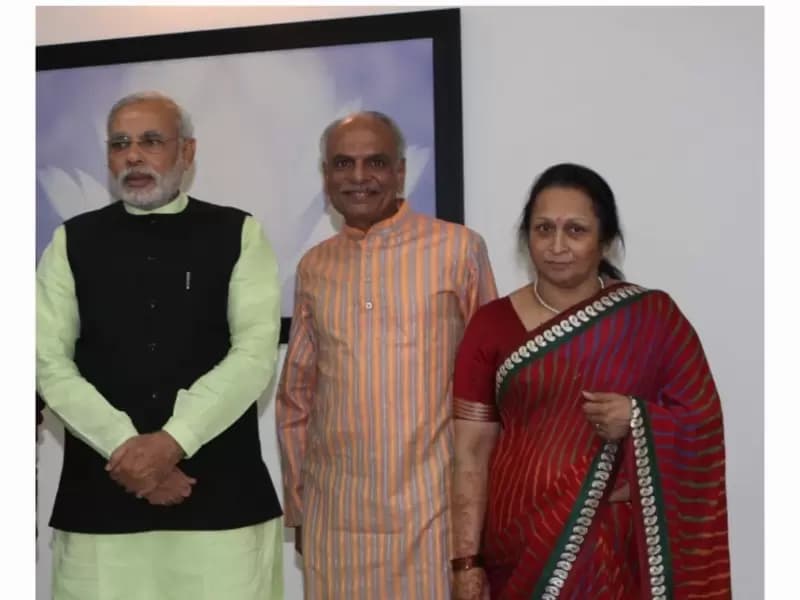
Sharad Amin with PM Modi / Courtesy photo
When Sharad Amin arrived in Houston in 1973, the city’s Hindu community looked very different from the sprawling network of temples, organizations, camps and celebrations that exists today.
Over the next five decades, Sharad ji would have a hand in building many of them.
From helping establish one of Houston’s early shakhas to launching a youth camp that now fills three sessions, assisting Bhutanese refugees, recruiting volunteers for the 2019 Howdy Modi event and organizing citywide Yoga Day events, Sharad ji has spent much of his adult life engaged in community service.
On Aug. 22, Hindus of Greater Houston will recognize that work with a lifetime achievement award at their annual gala.
“Sharad bhai, at the age of 75, stays a few nights at HHYC campsite and mentors young people,” said HGH leader Vijay Pallod. “He takes yoga sessions at camp. He is good at mediating disagreements between two volunteers. We have worked together for three decades. He is a visionary Hindu leader.”
“Sharad Amin is one of the most generous and hard-working volunteers in the Houston Hindu -American community,” said Beth Kulkarni. “His example of service is an inspiration to all who know him. I am pleased that he considers me his didi and rakhi-sister.”
Sharad Amin was born and raised in Bajuva, near Vadodara in Gujarat. His father, Suryakant Amin, was a businessman and a swayamsevak with the Rashtriya Swayamsevak Sangh.
“My father Suryakant Amin, who passed away at the age of 42, was RSS swayamsevak and his life was the main reason for me to get Sewa Samskar,” he said, referring to the ethos of service he later developed further under the guidance of mentors.
As a college student in India in the 1960s, young Sharad participated in a movement seeking technical training for the children of farmers whose land had been acquired for a Gujarat refinery. Students peacefully marched to deliver a memorandum to the refinery chairman, and the effort eventually resulted in the establishment of a training school for the young people.
“I realized the difference between volunteers and swayamsevaks very early in my life as I came in contact with the swayamsevaks of RSS in Bharat,” he said. “Swayamsevaks are self-inspired sevaks who within the system and with discipline render their services. They are selfless, they do not have any other agenda but serve for harmony and betterment of society.”
After earning a bachelor's degree in electrical engineering from Maharaja Sayajirao University in Vadodara and working for a year, Sharad ji moved to Houston in 1973 to continue his education.
While studying petroleum engineering at the University of Houston, he began volunteering with the Indian Student Association and Hindu Worship Society.
One of the people who made an impression on the young Sharad was the late Raj Syal, a prominent leader and founder member of HGH.
“No work was too small for him,” he said, recalling Mr. Syal’s dedication as a volunteer.
When Sharad ji was nominated as HGH president in 2012, Mr. Syal made the following comment-
“(Sharad Amin) is the man who unites everyone, silently yet diligently gets the job done and has significantly contributed to the Indian community through his service. He is very dedicated, sincere in his efforts.”
In 1978, Sharad ji joined a small group of swayamsevaks who began holding a shakha at the home of Houston community leader Ramesh Bhutada. The group later began meeting at Bayland Park.
Those early efforts became part of a much larger project: creating institutions through which Hindu immigrants could build a community in their new home while ensuring their children remained connected to their heritage.
Sharad ji became involved with the Vishwa Hindu Parishad of America, serving on its Governing Council and executive organizing committee. He helped launch Houston's Makar Sankranti kite-flying festival and citywide Janmashtami celebrations and was part of the founding team of Hindus of Greater Houston, where he later served as president.
But it is the Hindu Heritage youth camp, founded in the mid-1980s, that remains a particular source of pride.
The camp began under the supervision of adult volunteers before its organizers made a consequential decision: turn much of its operation over to the young people themselves.
College students and young professionals began taking responsibility for running the camp, creating a cycle in which children attended as campers, grew up to become counselors and returned year after year to pass the same traditions on to another generation.
Today, the Hindu Heritage Youth Camp has grown so popular that registration can fill within minutes. This year, three separate batches were held at its sprawling Columbus-area campus.
For Amin, its success is about more than numbers. Generations of Hindu American children have developed lasting relationships with their heritage — and with one another — through the camp.
His own family became part of that tradition. His daughter Sujata Vedantam and son Arpan both went on to serve as directors of the Hindu Youth Camp. To this day, the menu remains the same one chosen by his wife Amita, who devoted a great deal of time cooking for the young campers.
Sharad ji credits his wife with making his decades of community involvement possible. In the camp's early years, Amita ji helped raise money by making snacks at home and selling them at community fairs.
“All these things I could achieve because of my kind-hearted, caring wife Amita, daughter Sujata and son Arpan’s support,” Sharad ji said.
Sharad ji retired in 2016 after a long career as an instrumentation engineer.
Sharad ji’s idea of sewa, or service, also extended beyond the organizations he helped establish.
When Bhutanese refugees began arriving in Houston in 2008, he and other volunteers began helping families establish new lives in an unfamiliar country.
They collected clothes, furniture and household goods, but their assistance went further. Volunteers taught refugees how to prepare résumés, took them to libraries and helped them navigate the process of finding jobs.
Those efforts eventually helped develop into Sewa International's Houston chapter.
Sharad ji also helped launch Sewa's 5K walk/run activities and later became involved with programs serving seniors in the Sugar Land area.
Since the inaugural International Day of Yoga in 2015, he has also been involved in organizing Houston-area celebrations. In recent years, he has helped coordinate International Day of Yoga activities across Texas and surrounding states in conjunction with the Consulate General of India and community and yoga organizations.
One of the largest organizational challenges came in 2019.
When Prime Minister Narendra Modi visited Houston for the massive Howdy Modi gathering, Sharad ji helped recruit and train more than 1,000 volunteers for the event.
Sharad ji had met Modi ji on several occasions before Modi ji became India's prime minister, through his decades of involvement in Hindu community organizations and the RSS tradition.
Sharad ji has remained active with the Hindu Swayamsevak Sangh for decades, serving in roles including general secretary of the Southwest Zone and national public relations officer. Through the end of 2025, he was responsible for the organization's Jyeshtha Shreni program for members aged 50 and older. He now serves on the HSS Southwest Zone Executive Committee.
For Sharad ji, retirement did not mean withdrawing from community life. If anything, his volunteer schedule grew busier.
His service has also followed him outside Houston. Sharad ji said that when his professional travels took him elsewhere in the United States and abroad, including Trinidad, he looked for opportunities to help establish shakhas or other community activities.
He describes his contribution with a distinctly Hindu metaphor: his “Gilahary Prayas,” or “squirrel-like effort.”
The reference comes from the Ramayana, in which a tiny squirrel contributes to the enormous task of building the bridge to Lanka by carrying grains of sand. Those grains of sand helped fill the gaps and hold the bridge together.
It is an appropriately modest description for a man whose individual contributions, accumulated over more than half a century, have become intertwined with the growth of Houston's Hindu community.
As he prepares to receive Hindus of Greater Houston's lifetime achievement award, Sharad ji is quick to share the recognition with the people who shaped him.
He thanked the organization's board and advisory committee and paid tribute to the late mentors and community leaders who inspired him, including Dr. Chandrahans Misra, Raj Syal, Harshad Patel, Dr. Gopalkrishna, Hari Keval Ramani, M.B. Shintri, Dr. P.C. Sharma and Dilip Mehta.
“Because of the blessings and seeing all those serving the community selflessly,” he said, “I got inspired to work for the community. With the vision of a harmonious Hindu American society at present and potential for future,” he said, “my ‘Gilahary Prayas’ will go on.”
Discover more at New India Abroad.
ADVERTISEMENT
ADVERTISEMENT
Comments
Start the conversation
Become a member of New India Abroad to start commenting.
Sign Up Now
Already have an account? Login