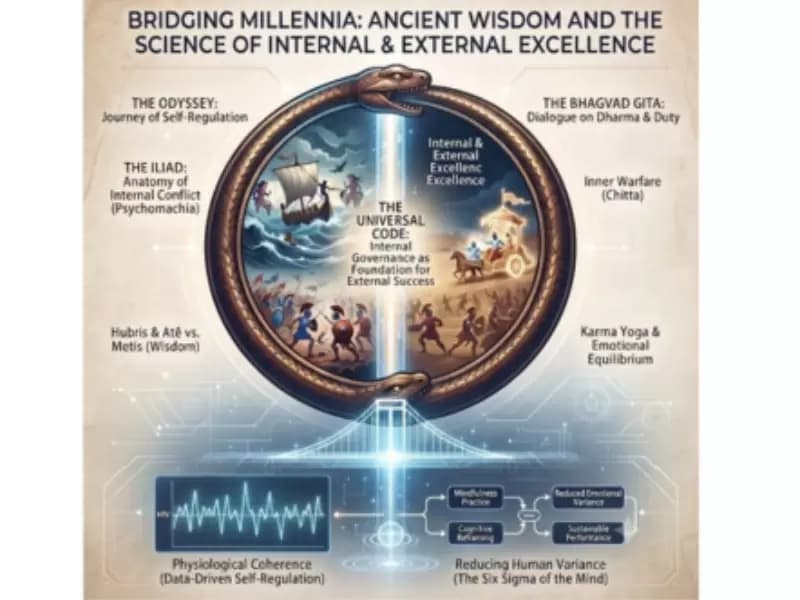
Representative Image / Generated using AI
As Christopher Nolan’s cinematic adaptation of The Odyssey races toward the $1 billion box-office mark, its blockbuster success couldn’t have come at a more opportune time. Humanity is currently facing profound existential risks, yet the ultimate antidote may be hiding in plain sight—encoded within the very message the ancient epic has been trying to convey for nearly three millennia.
The monumental epics attributed to Homer—the Iliad and the Odyssey—have captivated humanity for nearly three millennia. While generations have cherished them as thrilling tales of martial glory, divine intervention, and perilous seafaring adventures, ancient philosophers and modern scholars have long suggested that these texts harbor deeper, esoteric layers. Far from being mere entertainment, the epics function as vast psychological, philosophical, and moral blueprints.
Also Read: Christopher Nolan brings Indian touch to Odyssey film premiere
When examined closely, the underlying messages woven into these ancient verses align remarkably with a modern, unifying thesis: the framework of internal and external excellence. This framework posits that sustainable external achievement—operational success, societal leadership, and harmony—cannot exist without mastering the internal domain of human consciousness, emotional regulation, and self-restraint.
At first glance, the Iliad is an external catastrophe: a brutal, ten-year war fought on the plains of Troy over a geopolitical insult. Yet, classical thinkers as early as the 6th century BCE read the Trojan War as a psychomachia, or a battle within the human soul.
In this light, the opposing armies and legendary heroes are not merely historical or mythological figures; they are archetypes representing competing internal human faculties:
The Greeks and Trojans as Internal Factions: The Greeks often symbolize the rational, purposeful elements of human organization, while the Trojans represent the seductions of base desires, hubris, and emotional reactivity.
Achilles and Hector as Choice Architectures: Achilles embodies raw, unbridled passion and the pursuit of individual glory at all costs—a state of high emotional volatility that brings devastating external consequences. Conversely, Hector represents duty, domesticity, and the heavy burden of stewardship. Hector fights not for abstract glory, but to protect his community, highlighting the profound responsibility of leadership.
In the language of organizational and human systems, the Iliad demonstrates that external chaos is almost always a manifestation of internal misalignment. When leaders or societies are driven by unmanaged emotional variance—much like Achilles’ wrath—the result is systemic collapse and suffering. True external excellence requires recognizing and neutralizing these internal destructive forces before they erupt onto the world stage.
If the Iliad illustrates the perils of internal conflict, the Odyssey provides the operational manual for overcoming it. Odysseus’s ten-year journey home to Ithaca is a classic allegorical roadmap for the human soul navigating the hazards of life to attain wisdom and mastery. Every major obstacle Odysseus encounters corresponds directly to a psychological or physiological hazard that threatens human excellence:
The Lotus-Eaters: Representing the modern trap of comfort, passive distraction, and addictive forgetfulness, the Lotus plant makes individuals abandon their ultimate purpose. In personal development, succumbing to the “Lotus” is the abandonment of self-discipline in favor of immediate gratification.
The Cyclops (Polyphemus): The giant represents raw, unbridled anger, short-term thinking, and a complete absence of emotional restraint. When Odysseus foolishly taunts Polyphemus out of hubris, he invites disaster, proving that intellect without self-control is self-defeating.
Circe’s Temptations: Circe’s magic turns men into literal beasts, symbolizing how unchecked bodily appetites and primitive drives degrade human dignity. Odysseus is only saved because he consumes the herb moly—provided by the gods—which represents the stabilizing anchor of divine wisdom, mindfulness, and cognitive self-regulation.
Scylla and Charybdis: Choosing between these two terrifying hazards epitomizes the eternal challenge of navigating extremes. Excellence requires the precise navigation between ruthlessness and ruinous indulgence, demanding constant situational awareness and calibrated control.
Odysseus ultimately reclaims his kingdom of Ithaca not merely through physical strength, but through patience, disguise, strategic planning, and emotional endurance (metis). He must master himself in disguise before he can successfully restore order to his external realm.
Homer’s Odyssey is arguably history’s greatest metaphor for the human journey. It brilliantly illustrates the trials, tribulations, and distractions (the Sirens, Lotus-Eaters, Scylla and Charybdis) that keep Odysseus wandering for ten years. However, as a piece of literature, it describes what happened and that Odysseus finally reached home to Ithaca, but it stops short of providing a systematic, replicable operational blueprint for how ordinary human beings can quiet their minds, achieve inner mastery, and navigate their own modern "Ithacas."
A modern framework for internal and external excellence is the way. The core premise of this framework is that internal excellence—characterized by emotional stability, self-awareness, cognitive flexibility, and physiological coherence—serves as the foundational engine for external excellence, which encompasses organizational leadership, institutional integrity, and societal well-being.
Connecting Homeric wisdom to this modern paradigm reveals three profound parallels:
In industrial engineering, process control aims to minimize variance to eliminate defects and ensure high quality. Human beings also suffer from high variance: emotional outbursts, cognitive biases, and impulsive decision-making.
The ancient Greeks called this lack of control hubris and atê (ruinous delusion).
The Homeric epics warn that unmanaged internal variance leads directly to external catastrophe (the destruction of Troy, the loss of Odysseus’s crew). Modern frameworks formalize this insight, utilizing scientific protocols—such as mindfulness practices, cognitive reframing, and real-time physiological tracking (like Heart Rate Variability)—to dampen emotional turbulence and stabilize human performance.
Both the Iliad and the Odyssey teach that external authority is meaningless without internal governance. Agamemnon, the nominal king of the Greeks, repeatedly fails as a leader because he lacks internal self-mastery, allowing his ego and greed to fracture his coalition. Odysseus succeeds because he learns to endure suffering, suppress his anger, and subordinate his immediate impulses to a long-term vision.
In institutional and corporate leadership, external excellence cannot be achieved through rigid mandates or superficial policies alone. Sustainable success requires leaders who have cultivated internal excellence—fostering empathy, resilience, and ethical clarity within themselves and their teams.
Odysseus’s ultimate goal is not endless wandering, but nostos—the triumphant return home to restore peace, justice, and order to Ithaca.
Modern society finds itself wandering through its own metaphorical sea of information overload, chronic stress, and institutional decay.
Reclaiming our “Ithaca” requires a conscious cultural and educational return to foundational truths. By integrating the timeless psychological wisdom encoded in our classical heritage with rigorous, data-driven frameworks of human optimization, we can bridge the gap between technical capability and moral wisdom.
While the Greek epics use narrative metaphor to warn against the dangers of unmanaged emotional variance, the Bhagavad Gita approaches this exact same truth through direct philosophical instruction. Set on the battlefield of Kurukshetra—itself an unmistakable allegory for the internal conflicts of the human mind—the text centers on the dialogue between Prince Arjuna and Lord Krishna.
Arjuna experiences a crippling paralysis of will, overwhelmed by grief, anxiety, and moral confusion as he faces his duties. Krishna’s fundamental teaching is the doctrine of karma yoga and emotional equilibrium: external action without internal mastery leads to bondage and destruction.
Just as Odysseus must master his impulses and Achilles must confront his wrath, Arjuna must learn to quiet the “turbulent mind” (chitta). The Gita notes that the mind is notoriously restless and difficult to control, yet it can be mastered through abhyasa (consistent practice) and vairagya (detachment from ego-driven desires).
By bringing the Bhagavad Gita into the fold, we see that the framework of internal and external excellence is neither isolated nor accidental. Whether through the heroic wanderings of Greek myth or the profound battlefield dialogue of the East, humanity’s greatest sages have always converged on a singular, urgent message:
“To conquer the world, you must first conquer yourself.”
The “hidden messages” of the Iliad and the Odyssey are not cryptographic puzzles left by a long-dead poet; they are mirror reflections of the human condition. They remind us that the greatest battlefields are not outside us on the plains of Troy or across stormy seas, but within the theater of human consciousness.
By viewing these ancient epics through the lens of internal and external excellence, we discover that their timeless wisdom is more relevant today than ever. True progress—whether for an individual, an institution, or a global civilization—begins when we master the internal domain, harmonize our cognitive and emotional systems, and apply that inner clarity to build a more resilient, peaceful, and excellent world.
(The views and opinions expressed in this article are those of the author and do not necessarily reflect the official policy or position of New India Abroad.)
Discover more at New India Abroad.
ADVERTISEMENT
ADVERTISEMENT
Comments
Start the conversation
Become a member of New India Abroad to start commenting.
Sign Up Now
Already have an account? Login