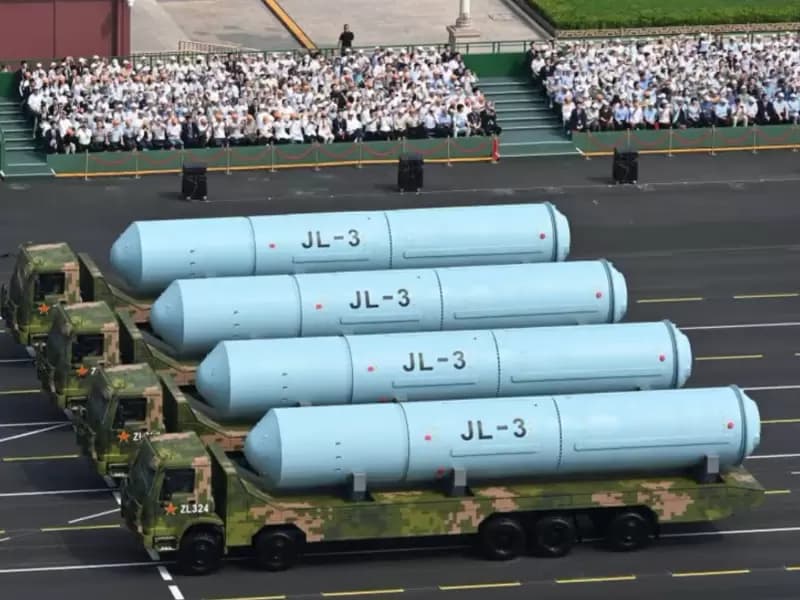
Chinese SLBM JL-3 on display at a military parade in September 2025. / Xinhua
July 6, 2026 caused a major ripple in the strategic equilibrium of the Indo-Pacific region as China launched its first publicly-acknowledged submarine-launched ballistic missile (SLBM) test and its first SLBM test into international waters. It was most likely launched from Beijing’s only Submarine Ballistic Missile Nuclear (SSBN) known by the public to be in active service – the Jin/Type 094 submarine – and probably carried either the JL-2 or JL-3 with a dummy nuclear warhead.
This SLBM test unexpectedly validated Beijing’s nuclear triad, providing the state with a potent second-strike capability under its ‘no-first use’ (NFU) nuclear policy. The nuclear triad comprises DF-41/DF-31 land-based intercontinental ballistic missiles (ICBMs), JL-3 sea-based SLBMs, and JL-1 air-launched ballistic missiles from the H-6N bomber.
Although, Chinese military modernisation and strategic ambiguity make it difficult to believe this policy.
China has 620 nuclear warheads, more than 775 missile silos and 350 new silo launchers. It is constructing more than 80 new launchpads and is making rapid progress on its most advanced submarine yet, the Type 096.
Launch Platform: JL-2 or JL-3?
The Julang (JL)-2 is a second-generation SLBM of the People’s Liberation Army Navy (PLAN), deployed on its nuclear-powered Jin-class Type 094 submarines while the JL-3 is the third-generation version of the JL-2. As a solid fuel, three-stage missile, it could carry multiple independently targetable re-entry vehicles (MIRVs) with up to three nuclear warheads, and a range of at least 10,000 kilometres. The JL-3 will ultimately be deployed on the Type 096 submarines, entering service in five to seven years. It is an upgrade to the JL-2, developed to replace it. Its range enables Beijing to easily target both New Delhi and Washington DC from the relative safety of its sovereign waters, without any real need to launch from too far off its coast.
According to William Alberque (previously Director of NATO’s Arms Control, Disarmament, and Non-Proliferation Centre), the SLBM’s 10,000-kilometre test flight makes it more likely to have been the JL-3; if it was the JL-2, it would have really been pushing its 8,000-9,000-kilometre range. He goes on to suggest that this test was for a new platform rather than an older one as it was China’s first Pacific test at these distances. On the other hand, Taiwan’s National Security Adviser, Secretary-General Joseph Wu, had posted on X asserting that the missile was a JL-2.
Flight path of the JL-2 SLBM, as per Secretary-General Joseph Wu, NSA of Taiwan. / X: @josephwutwThe first country in the world to take delivery of the supersonic BrahMos cruise missile was the Philippines, receiving the first of its three batteries in April 2024. India and Vietnam in May 2026 agreed on a deal for New Delhi to export the world’s fastest cruise missile system to Hanoi, followed by Jakarta also signing a deal in July 2026. There are two key reasons for Southeast Asia’s realisation of BrahMos as an effective strategic tool – the increasing frequency of Chinese missile testing in the Indo-Pacific and its maritime aggression, and the various territorial and other disputes the region has with China.
Beijing established its nuclear triad between 1964 and 1982 through atmospheric, airborne and underwater testing at Lop Nur, with its first test in October 1964. In the 1960s, a covert joint India-US Intelligence Bureau-Central Intelligence Agency expedition attempted to plant a plutonium battery-powered surveillance device on Nanda Devi to monitor these tests but the device was lost in an avalanche and remains unrecovered. While China signed the Comprehensive Nuclear-Test-Ban Treaty (CTBT) in 1996, it faces modern US allegations of conducting covert, low-yield nuclear tests at its legacy site. In February 2026 at the UN Conference on Disarmament in Geneva, US Under Secretary of State for Arms Control and International Disarmament, Thomas DiNanno, publicly accused China of conducting a nuclear test on 22 June 2020. It would be notable to recall that the Galwan Valley Clash took place on the night of 15/16 June, just over a week after the test with tensions still extremely high. Having transitioned to a more assertive posture, Beijing has shifted its recent long-range missile tests from its interiors to open-ocean Pacific launches.
The day of the SLBM test coincided with Indian Prime Minister Narendra Modi beginning his tour of Indonesia, Australia and New Zealand; the signing of the Veitacini Treaty/Ocean of Peace Alliance between Australia and Fiji; and Exercise Joint Sea-2026 between Russia and China. It could also serve as an early welcome to the US and its allies for Exercise RIMPAC 2026 which opened on 24 June. A section of experts links the test to these developments. Although William Alberque disagrees and considers it highly unlikely to be planned to coincide or serve as a retaliation, he goes on to write that these test dates can be changed marginally “… to improve signalling or amplify internal or external messaging…” but “… they are planned so far in advance that it is as likely to be chance or opportunism a planning.” A subdued Beijing following the successful test is indicative of a real operational test rather than just signalling. Weather is also another important factor that plays a part in deciding the launch window of these tests.
Under the Hague Code of Conduct (HCOC), all 144 signatories of the Treaty are bound by international law to provide a 24-hour advance notification before conducting missile tests. Information on the launch area and direction, and the general class of the missile being tested also needs to be shared. But China is the sole country with ballistic missiles and space capabilities that is not a signatory of the HCOC, and thus without any such obligation. It only informs countries on an ad-hoc basis with a very short lead time, minimal information and negligible transparency.
Chinese missile test notifications versus the Hague Code of Conduct. / Courtesy photo
The launch site in the South Pacific falls within the South Pacific Nuclear Free Zone established by the 1986 Treaty of Rarotonga: a treaty China ratified in 1987, pledging not to test nuclear weapons within the zone but blatantly flouted. China states it was not in breach of the Treaty as the test was neither a credible threat, nor did it involve a nuclear explosion. The view from the South Pacific islands is one of disappointment: having spent years and billions of dollars on infrastructure and investment, one missile test could potentially throw away China’s time, effort and financial commitments.
Even the ‘India-Pakistan Pre-Notification of Flight Testing of Ballistic Missiles of 1999’ stipulates a three-day advance notice through a notification to airmen (NOTAM) and naval area warnings (NAVAREAs) by the Foreign Offices and High Commissions, with the test launch site not within 40 kilometres and the intended target area not within 75 kilometres of either the International Boundary (IB) or the Line of Control (LoC), maintaining a horizontal distance of 40 kilometres from the IB.
The world’s most famous hotline is from the Cold War, between the USA and the former Soviet Union, used to great effect following the Cuban Missile Crisis of 1962.
India and Pakistan have established five hotlines as outlined in the table below. The most one is between the two Director Generals of Military Operations (DGMOs) as it is a weekly event, serving as the mechanism by which India ended the Pakistani attacks in May 2025 immediately after the Pahalgam massacre. In April 2010, India announced it would establish a hotline with China between the two Prime Ministers. The only other country India has a hotline with is Russia.
The graphic shows the various hotlines each country has around the world, and at which level. / Compiled from various sources by the author as a graphic.Harry I. Hannah (previously a senior analyst in the US intelligence community with expertise on South Asian strategic issues) has made a case for New Delhi and Islamabad to establish “… a dedicated, secure, and redundant 24/7 … “hotline” – between their respective …” National Command Authorities (NCAs). While there are significant benefits in having a dedicated ‘nuclear hotline’, the level of mistrust is far too great to realise this, especially after the wave of Pakistani terrorist attacks in 2016, 2019 and 2025.
As Beijing publicly validates its nuclear triad – especially its survivable, long-range sea-based leg – it is altering the Indo-Pacific’s balance of power. Operation Sindoor made New Delhi realise the bandwidth of warfare available below the nuclear threshold but has been quietly moving towards faster operational deployment of its nuclear warheads.
Now that China has a credible nuclear triad for a secure second strike, Beijing could possibly resort to aggression along the Line of Actual Control (LAC). Having reportedly tested the JL-3, its nuclear submarine fleet can deploy closer home, increasing the chances of patrols deep into the Indian Ocean Region (IOR), more frequently and with greater complexity.
In 2025, India expanded its overall stockpile from 180 to 190 warheads and has officially moved a portion of its arsenal out of storage. It has operationally deployed an estimated 12 nuclear warheads, placing its retaliatory forces on a much higher state of readiness to counter the rapidly expanding arsenals of its neighbours.
New Delhi believes in the advantage of having a secure and credible nuclear triad, focussing on the development of its sea-based leg as it is the most challenging to monitor. It is believed that the newly deployed warheads are believed to be integrated onto India’s Arihant-class SSBNs. India has achieved ‘continuous at-sea deterrence’ with the deployment of these armed submarines on deterrence patrols: when at least one nuclear-armed submarine is constantly patrolling undetected, ready to launch a retaliatory strike if India’s land-based systems are ever compromised.
India continues to maintain its NFU nuclear doctrine despite putting its arsenal on a higher state of alert and expanding its deployed forces. These deployments and modernisation efforts are seen as a necessary evolution to maintain its credible minimum deterrent against nuclear coercion rather than an attempt to match China’s raw numbers in an aggressive arms race. Its inaugural MIRV test in May 2024 was followed up by testing its advanced version two years later in May 2026.
Beijing must sign up to the HCOC. Some potential pathways for this could include leveraging China being a ‘responsible power’ narrative; underlining its diplomatic isolation as more than 140 powers have signed, including all major space powers; linking transparency and space exploration; providing reassurance on space warfare; widening the scope of the Conduct’s platforms; focusing on UN frameworks; and utilising Track-II diplomacy. New Delhi’s push for a United Nations Security Council seat should be followed up with international pressure on China to do so, or a combination of the pathways.
Siddhant Hira is a Member of Team Grey-Zone and Influence, Irregular Warfare Initiative (USA)
(The views and opinions expressed in this article are those of the author and do not necessarily reflect the official policy or position of New India Abroad.)
Discover more at New India Abroad
ADVERTISEMENT
ADVERTISEMENT
Comments
Start the conversation
Become a member of New India Abroad to start commenting.
Sign Up Now
Already have an account? Login