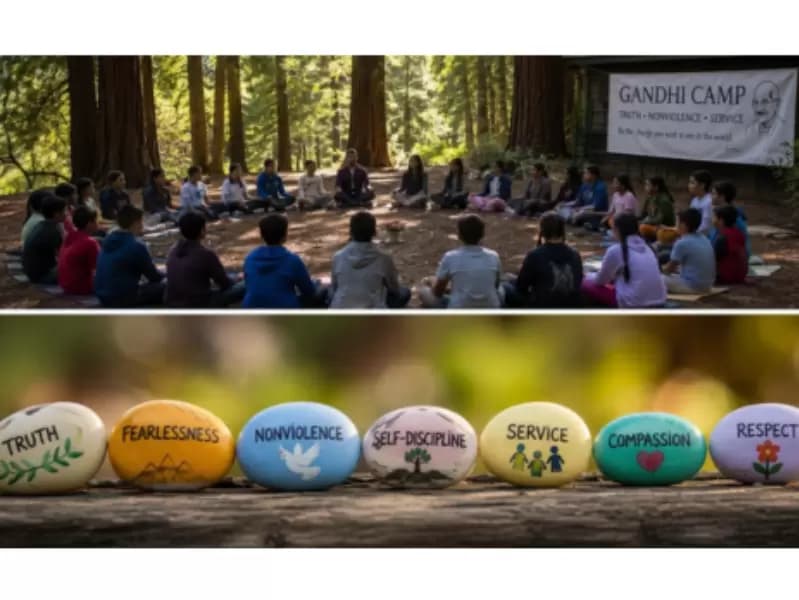
Representative Image / Generated using AI
It seems like an odd question. Most parents, teachers, and community leaders would instinctively answer yes. Schools have character education programs. Religious institutions teach moral values. Families tell stories intended to shape children's character. We explain honesty, kindness, compassion, courage, and service, hoping that understanding these values will eventually translate into how children live.
After spending a week with sixty-four young people at Gandhi Camp this summer, I returned home wondering whether that assumption is entirely correct.
For many years, when people asked what children learned at Gandhi Camp, I would describe the activities. We told stories from Gandhi's life, meditated together each morning, discussed values every evening, played games, sang songs, and shared meals. All of that happened. Yet this year I realized it was not what mattered most.
Also Read: Beyond Success: Indian Americans and Universal Oneness
The children certainly learned about Gandhi. But what stayed with me was a question that has occupied me for much of my professional life: How do human beings actually develop?
Never before have children had easier access to information. Yet information has never been the same as wisdom. There are scholars who explain the Bhagavad Gita and the Upanishads beautifully. Books, videos, and even AI can tell Gandhi's stories with remarkable clarity. If information alone produced wisdom, we should be living in a remarkably wise world.
Yet wisdom remains difficult to cultivate.
I began to wonder whether we have been asking the wrong question. Instead of asking, How do we teach values better? perhaps we should ask, What kind of environment allows values to grow?
That insight emerged from many small moments throughout the week.
Even before camp began, we asked every child to write an essay—not about Gandhi, but about a problem they genuinely cared about. Some wrote about bullying, loneliness, environmental responsibility, excessive screen time, kindness, or helping younger children succeed. They described one action they could take themselves, another that would require others, and how they might inspire broader participation.
Looking back, I now realize that this simple assignment shaped the entire camp. The children did not arrive waiting to be told what mattered. They arrived carrying questions that already mattered to them. Our role was no longer to convince them that compassion or truthfulness were important. Instead, we helped them examine their own questions through those values.
The morning meditation sessions revealed something similar. We were not trying to make children expert meditators. We were helping them become more attentive—to their breathing, thoughts, emotions, and reactions. Later in the week, we introduced the idea of becoming a witness to one's own experience. Can I notice my anger before it becomes harsh words? Can I recognize fear before it controls my actions? Without awareness, there is little freedom to choose.
The evening discussions took that awareness a step further. Instead of delivering lectures, we increasingly found ourselves asking questions. When we explored fearlessness, children spoke about their own fears. When we discussed truthfulness, they wrestled with situations involving friendship, loyalty, and kindness. They quickly discovered that life is rarely as simple as a moral slogan.
What impressed me most was that many of the deepest insights did not come from the adults. They emerged as children listened carefully to one another. One child's experience helped another see a problem differently. A disagreement became an opportunity to appreciate nuance rather than win an argument.
One moment after the camp particularly stayed with me. As judges reviewed the essays, they did not choose the most polished writing. They consistently gravitated toward essays that demonstrated ownership and initiative. One judge remarked that a winning essay left her feeling empowered because the student had moved beyond describing a problem to taking responsibility for addressing it.
Education often rewards how well children express ideas. Life ultimately rewards whether they act upon them.
The camp was changing the adults as well. Junior counselors gradually shifted from solving children's problems to asking thoughtful questions and allowing them to think for themselves. I realized that Gandhi Camp was not simply developing children. It was becoming a developmental environment for everyone within it.
As I reflected on the week, one insight became increasingly clear. Perhaps our responsibility as parents, teachers, and community leaders is not simply to explain values more clearly. It is to create environments where children learn to observe themselves, think critically, listen respectfully, appreciate life's nuances, and choose meaningful action.
Gandhi did not merely ask people to admire his principles. He invited them to experiment with their own lives.
So, can values be taught? My experience at Gandhi Camp suggests that the answer is both yes and no. We can certainly teach the language of values, tell stories that illustrate them, and discuss their importance. But values take root only when children discover them through their own observations, conversations, choices, and actions. Perhaps our responsibility is not simply to teach values, but to create environments in which values can be lived, questioned, refined, and ultimately owned.
That is the lesson I brought home from Gandhi Camp this year.
(The views and opinions expressed in this article are those of the author and do not necessarily reflect the official policy or position of New India Abroad.)
Discover more at New India Abroad.
ADVERTISEMENT
ADVERTISEMENT
Comments
Start the conversation
Become a member of New India Abroad to start commenting.
Sign Up Now
Already have an account? Login