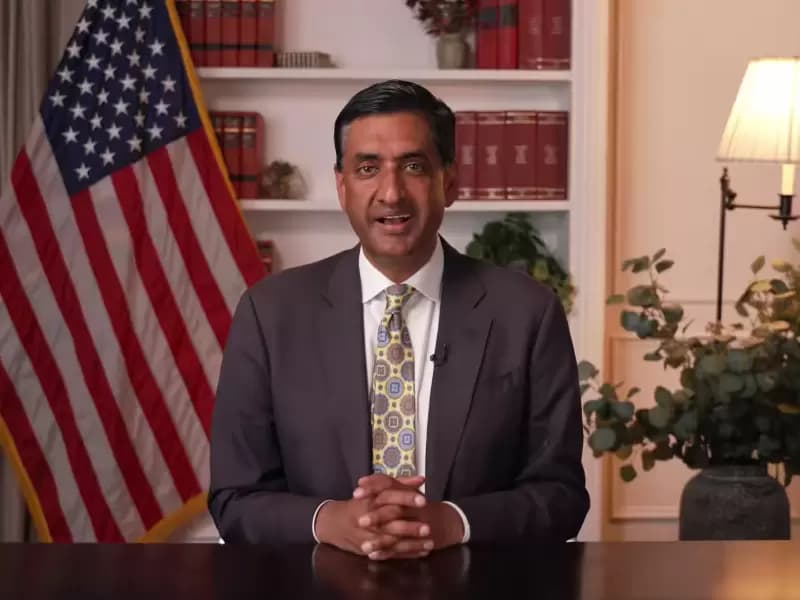
Rep. Ro Khanna delivers an Independence Day message reflecting on his family's Indian immigrant journey and America's future. / X/@RoKhanna
Rep. Ro Khanna said lawmakers should not be allowed to use campaign contributions to defend themselves against sexual misconduct allegations, as he introduced bipartisan legislation with Rep. Anna Paulina Luna that would prohibit federal politicians from using campaign funds or legal defense funds for related legal expenses and settlements. Khanna said the measure is intended to increase accountability by requiring elected officials to rely on their personal financial resources instead.
The bill, introduced by Khanna, a California Democrat, and Luna, a Florida Republican, would prohibit elected officials and candidates for federal office from using campaign donations or legal defense funds to pay legal fees related to allegations of sexual assault, sexual abuse or sexual harassment. If they are ultimately not held liable, they could be reimbursed for those expenses.
I’m proud to introduce bipartisan legislation with @RepLuna to prevent federal elected officials from using campaign funds to go after survivors who bring claims of sexual assault or harassment.
— Rep. Ro Khanna (@RepRoKhanna) July 28, 2026
Thank you to @CheyenneHuntCA for your work and leadership on this issue. pic.twitter.com/ryprqKrZoL
Khanna said allowing politicians to rely on campaign accounts creates the wrong incentives.
“That creates this culture of impunity where people think they’re untouchable,” Khanna said in an interview.
He said elected officials benefit from “the extraordinary legal advantage that elected officials have,” adding that “there’s such a power asymmetry.”
The proposal would also prohibit campaign contributions from being used to pay settlements or court-ordered judgments in sexual misconduct cases. It would further bar the use of campaign funds to hire private investigators or pay for research targeting accusers.
Khanna said elected officials should be free to use their own savings to defend themselves, as other Americans do, but should not be permitted to raise campaign money for expenses that often extend beyond legal representation.
“In most of the cases, they’re being used to smear survivors,” he said.
Luna said the legislation is overdue and would serve as a “massive deterrent” to misconduct on Capitol Hill.
“It is not what the Founding Fathers intended for members of Congress,” she said. “It’s a perversion of the system.”
The legislation follows months of scrutiny over how Congress handles sexual misconduct complaints after a series of allegations prompted lawmakers to revisit workplace protections for Capitol Hill staff. Khanna and Luna have both been active in those discussions.
According to the lawmakers, the proposal emerged from conversations with activists supporting women who have accused politicians of sexual misconduct, including former California congressman Eric Swalwell.
In April, the San Francisco Chronicle reported that a former Swalwell staffer accused him of sexually assaulting her. CNN later reported additional allegations of inappropriate behavior, while a second woman accused him of rape. Swalwell has denied the allegations, calling them a political hit job, while acknowledging some “mistakes in judgment.”
After leaving office, Swalwell spent $50,000 from a former congressional campaign account and hundreds of thousands of dollars from his gubernatorial campaign on attorney Sara Azari. According to NOTUS, her firm also hired a private investigator to examine the allegations.
“Many of those women were forced back into hiding, and this ordeal is still not over for them,” said Cheyenne Hunt, who worked with some of the accusers and later founded the advocacy group Reckoning Action.
Hunt described the use of campaign funds as retaliation and a “bad-faith use” of donor money.
“No donor gives to a campaign thinking, ‘Yes, I want my money to go toward harassing a survivor,’” she said. “This truly feels like such a no-brainer.”
The bill has bipartisan sponsors, but its future remains uncertain as Congress continues to debate broader proposals aimed at strengthening workplace protections and addressing sexual misconduct on Capitol Hill.
Discover more at New India Abroad.
ADVERTISEMENT
ADVERTISEMENT
Comments
Start the conversation
Become a member of New India Abroad to start commenting.
Sign Up Now
Already have an account? Login