ADVERTISEMENT

ADVERTISEMENT

India feels Indus Water Treaty can't exist in current form

Officials linked the water-sharing treaty as a means of cross-border terrorism in Pakistan.

 Indus River Indus River /

Even as Pakistan is attempting to rally global support for its demand that India restores the Indus Water Treaty (IWT) that its South Asia neighbour has kept in abeyance ever since the dastardly Pahalgam attack which saw Pakistani terrorists kill as many as 26 Indians, mostly tourists in Kashmir's picturesque Baisaran valley, India is in no mood to revert to the pre-2025 position of the IWT as it continues to link the treaty's restoration with its stand that Pakistan should halt cross-border terrorism. 

Sources in the government of India have said that India is not inclined to revert to the old situation vis-a-vis the IWT which has outlived three wars between India and Pakistan, adding that India was not in favour of continuance of the treaty in its current form.

A top official of the government of India briefed select journalists on the issue on Monday and remarked that "staying in the Indus Water Treaty was not in India's interest."

Also Read: Pakistan’s fake narrative against India to hide its own mismanagement of Water Resources

A source present in the meeting said that the official hinted that India was of the view that by resorting to terrorism, Pakistan had destroyed the very foundation of the treaty.

Highly-placed sources in the government of India hinted that India may consider revisiting the treaty to modify it according to the realities of today on different fronts including climate change, rising need of water, glacier retreat and altering hydrology.

"India is not keen on reverting to the pre-2025 situation when the water-sharing between the two nations was being done in line with the provisions of the IWT which is a 65-year-old treaty that was signed between the two neighbours in September 1960. The country feels that the treaty cannot exist in its present form," a source privy to the developments said.  

In fact, India is keen on modifying the treaty - something that it had called for in January 2023 when it had sent a notice to Pakistan under Article XII (3) of the IWT, asking for modifications in the treaty. The article deals with the final provisions of the treaty.

While India had stopped hydrological data sharing with Pakistan as it decided to put the treaty in indefinite abeyance, Pakistan which had till April 2025 taken for granted India's stance on the IWT, started bearing the brunt of the decision.

Being a lower riparian state, hydrological data is critical for water management. This data includes information about the flow of the water of the rivers, snowmelt along with the river discharge.

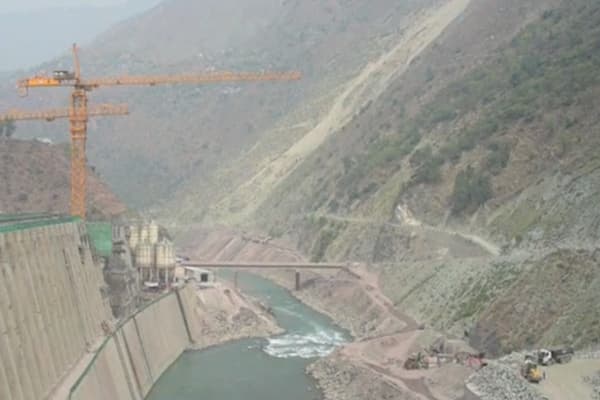
India is also attempting to fully utilize the waters of the Chenab river - one of the three western rivers that, under the IWT, are to be controlled by Pakistan. Along with two hydroelectric power plant projects due to be commissioned on the river, India also plans to implement five other hydroelectric power plant projects - four on river Chenab and one on river Jhelum, another western river of the Indus river system.

In  an article that analysed India's decision to put the IWT in abeyance, Dr. Dhrubajyoti Bhattacharjee, research fellow at the Indian Council of World Affairs, New Delhi had noted that  with the treaty in abeyance, India was not bound to any restriction on the usage of the Western rivers, Indus, Jhelum and Chenab.

"If the suspension continues, India will be able to enhance or build new storage or hydropower projects and manage water flow more freely. India should also refuse to allow Pakistani officials to enter India for any joint inspections of the existing flow in the future. India has the option, in the future, to limit or cut off the flow of water into the Indus, Jhelum, Chenab, Ravi, Beas, or Sutlej rivers by diverting the water into canals and channels, or by raising storage levels in its existing dams and reservoirs. Modifying the existing infrastructure itself will immensely benefit Indian agriculture and irrigation. For instance, India could opt to halt or decrease the flow of water into the Upper Bari Doab Canal on the Ravi River, one of the oldest barrages on the Ravi-Beas River system, built prior to Independence," he noted.

Even before the Pahalgam attack of April 2025, India had said that there were issues in the treaty that needed clarification or changes in consonance with changing climate and demographic changes. 

"From the time the treaty was signed, Pakistan has been getting 80.52  per cent   of the total waters of the six-river Indus system — and almost 100 per cent of the western rivers’ waters. With the Indus system’s smaller three rivers reserved for India, the latter's share is just 19.48  per cent   of the total waters under what can be seen as one of the most disputable, lopsided and inequitable water-sharing treaty which India has abided to all these years," Bhattacharjee had noted.

Also Read: Anita Anand concludes Pak visit, leaves for Manila ASEAN summit

India's stand has been made clear by the official at a time when Pakistan is attempting to rally global support for the restoration of the treaty.

Islamabad had on July 20 sought Canada's support to nudge India for the restoration of the treaty.

Its deputy prime minister Ishaq Dar while addressing a joint press conference with Canada's foreign minister Anita Anand, said that by putting the IWT in abeyance, "India had added a new dynamic into an already volatile security situation."

Seeking the support of "friendly countries including Canada," Dar while seated next to Anand in Islamabad sought their assistance to ensure "India immediately restored the IWT and upheld international law and treaty obligations as per international law and practices " even as he called India's move as "weaponization of water."  Earlier, Pakistan People's Party chief Bilawal Bhutto Zardari had also issued a warning to India over the fallout of the move stating that the country had been using water as a weapon.

Last year, India's prime minister Narendra Modi  had said that "blood and water cannot flow together," asserting that the IWT would remain in abeyance till Pakistan takes credible and verifiable action against terror groups operating from its territory.


Discover more at New India Abroad.

Comments

Leave A Comment

Required fields are marked (*).

Related

Talk to us?