ADVERTISEMENT
ADVERTISEMENT



From Colony to Cornerstone: India at 80 and the Arc of Indo-U.S. Relations
Democratic traditions run deep in Indian civilization, and it is fair to say that India is a pluralistic society
-
 Avatans Kumar
 - Sat, 15, Aug 2026
- 04:38 EDT
- 34
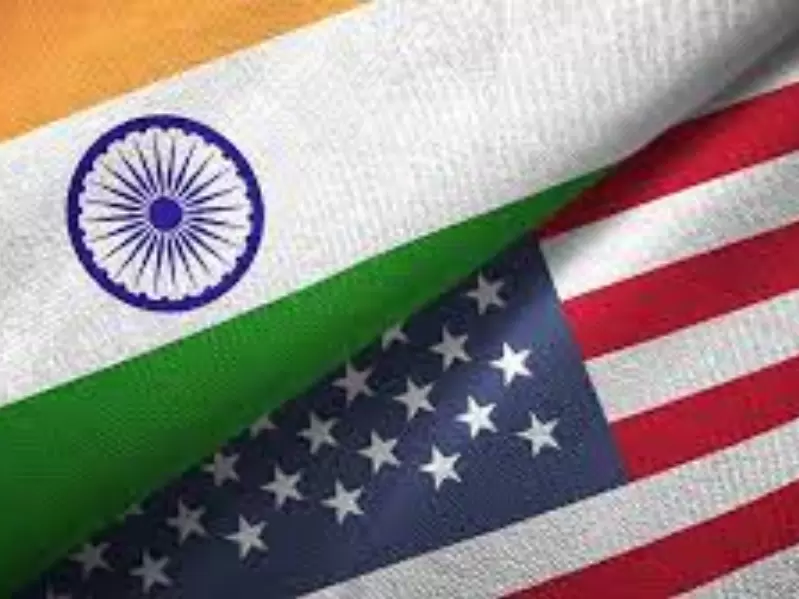
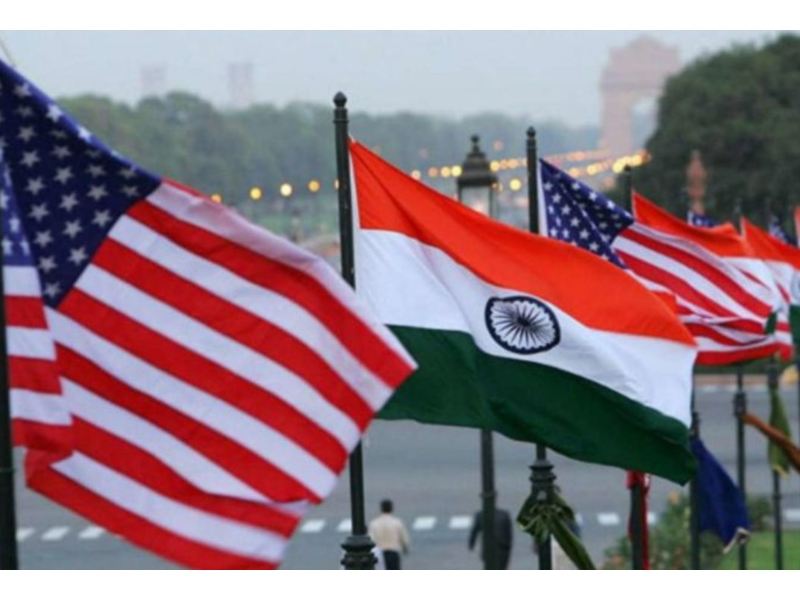 India US flags. / Photo courtesy: U.S. Embassies and Consulates in India website
As the United States marked its 250th Independence Day on July 4, India is about to begin its 80th year as a modern sovereign republic. Modern India's history took a major turn 79 years ago, on Aug. 15, 1947. This day marked freedom from British colonial rule, but it is also remembered for the tragedy of Partition, which Indians always refer to with a capital P.
The Indian Independence Act, passed by the British Parliament on July 18, 1947, created two new countries: India and Pakistan. On that day, the great Indian nation, home to one of the world's oldest civilizations, was divided.
When Louis Mountbatten was appointed viceroy of India in February 1947, he was tasked with ending British rule by August. He arrived in India later that year in March. The British government also chose Cyril Radcliffe, a lawyer with little knowledge of India's culture or geography, to lead the Boundary Commission and gave him only a few days to draw the new borders. As a result, Pakistan, East (now Bangladesh) and West, was created on Aug. 14, and India declared independence on Aug. 15, 1947.
The violence before and after Partition remains one of history's greatest tragedies. Some estimates say nearly 2 million people died, though the real number may be even higher. It was a tragedy that no one expected and none deserved.
Some British historians see India's Partition as a generous act, saying Britain left India peacefully and helped set up the Commonwealth after two centuries of colonial rule. Others argue that Partition shows colonialism failed to bring real modernization. Historian David Gilmartin described Partition as "an illustration of the failure of the ‘modernising’ impact of colonial rule, an unpleasant blip on the transition from the colonial to the post-colonial worlds" in the Journal of Asian Studies (November 1998).
As India emerged from the shackles of centuries of British and Islamic colonization, its leaders made a clear choice to build the world's largest democracy, even though many doubted it was possible. Despite widespread poverty and challenges from Partition, India introduced universal adult suffrage, adopted a Constitution with guaranteed rights, established an independent judiciary and kept the press free. Eighty years later, India remains a vibrant multiparty democracy and holds the largest elections in the world. It also stands as the third- and sixth-largest economy in terms of purchasing power parity and nominal GDP, respectively.
Democratic traditions run deep in Indian civilization, and it is fair to say that India is a pluralistic society. While academic and popular accounts often describe India as a monarchy, the country had many forms of self-rule, a cooperative self-government similar to Greek republicanism in the West.
The Vedas, India's ancient texts, hint at self-government through terms like sabha, samiti, parishad and sabhapati, but clearer evidence appears during the time of Gautama the Buddha in 600 B.C.E. (according to J.P. Sharma, Republics in Ancient India c. 1500 B.C.-500 B.C.). At the time of Alexander of Macedonia's invasion, several sovereign republics existed in India. Greek writings, such as Arrian's Anabasis of Alexander, include eyewitness accounts of Alexander meeting "free and independent" Indian communities almost everywhere he went.
The Ashtadhyayi by the well-known Sanskrit grammarian Panini includes complex terms such as gana and sangha that refer to self-governing groups (V.S. Agrawala, India as Known to Panini). It contains one of the earliest descriptions, dating from the seventh to ninth century C.E. The Uthiramerur temple inscription in Tamil Nadu has one of the earliest descriptions, dating from the seventh to ninth century C.E., of some essential elements of a democratic process, such as conducting an election.
India's status as a modern republic has roots in a civilization that has lasted thousands of years. India's long tradition of inquiry, debate and disputation has been the bedrock of the civilization.
Before independence, India was a major center of learning. As early as the fifth century C.E., Nalanda University attracted scholars from across Asia. The mathematician Aryabhata introduced the concept of zero and early ideas about the solar system. Takshashila saw progress in medicine, law and philosophy. Sanskrit texts on grammar, logic, astronomy and metallurgy appeared before similar works in Europe. Ayurveda and yoga, also a school of philosophy, both important Indian contributions, are now practiced worldwide. Several abstractions of the modern notion of computing are found in the sutras, or aphorisms, of Sanskrit grammarian Panini's Ashtadhyayi.
Owing to its long knowledge tradition, India plays an important role in science, technology and higher education. The focus on knowledge in Indian society is also seen in U.S.-India collaborations, such as partnerships between NASA and ISRO and joint work in artificial intelligence and semiconductors. Many Indian scientists, engineers and academics hold key positions in American universities, research labs and tech companies.
Each country shows its commitment to democracy in its own way, and politicians from both the United States and India often describe their relationship as a partnership between the world's "oldest" and "largest" democracies. However, during most of the Cold War, historians called India and the United States "estranged democracies."
The distance between the two countries came from India's nonalignment policy, its close ties with the Soviet Union, and events like the 1971 war and the 1998 nuclear tests. Things changed in the early 2000s, especially after the 2005 U.S.-India Civil Nuclear Agreement, which let India join the global nuclear community even though it had not signed the Non-Proliferation Treaty. Since then, politicians from both U.S. parties have seen India as an increasingly important partner, mainly because of shared concerns about China's rise, growing trade and technology links, and the large Indian diaspora in the United States.
The immediate years leading up to the 80th anniversary were challenging. In 2025, during the second term of President Donald Trump, the relationship between India and the United States was at its lowest point in a generation. The United States imposed severe tariffs on Indian imports that strained a relationship built over two decades and gave other countries a chance to strengthen their ties with New Delhi.
Over the past 80 years, India and the United States have progressed from a careful and distant relationship to one that is now deep, although at times frosty and unpredictable. As the events of the past years have shown, short-term political considerations can still influence it in both countries. However, despite some bumps and roadblocks, the U.S.-India relationship is significant. Their common economic, technological and geopolitical interests indicate that as India reaches its centennial of independence in 2047, its partnership with the United States will continue to be one of the most important relationships of the 21st century, guided by shared democratic values and practical decisions.
Discover more at New India Abroad.
Leave A Comment
Related

ADVERTISEMENT

ADVERTISEMENT
E Paper
Video

Comments
Start the conversation
Become a member of New India Abroad to start commenting.
Sign Up Now
Already have an account? Login