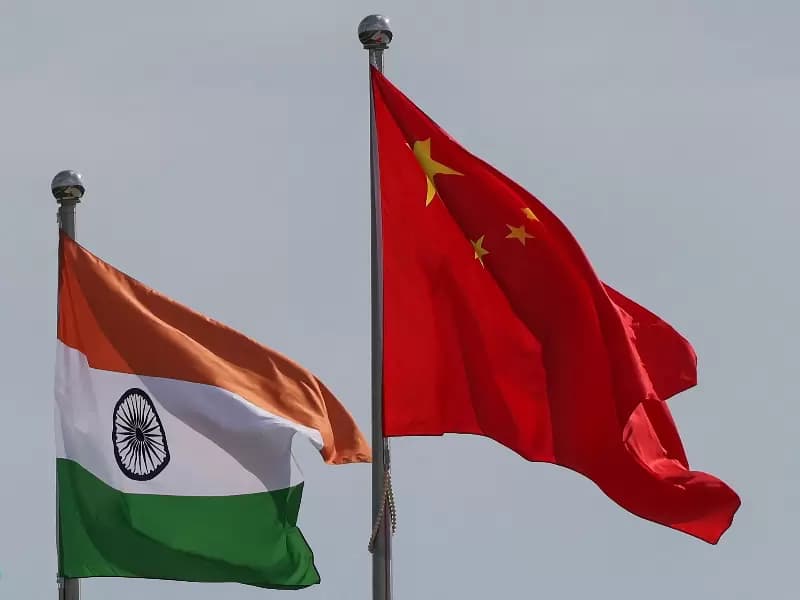
National flags of China and India fly next to the Meijiang Convention and Exhibition Center, a venue for 2025 Shanghai Cooperation Organisation (SCO) summit in Tianjin, China August 30, 2025. / REUTERS/Maxim Shemetov
It was a historic day for India-China ties as the two Asian giants resumed trade via the Nathula Pass after a six-year hiatus on Aug. 1- bringing alive trade between the two countries via the oldest commercial routes along the ancient Silk Route.
Trade via the Pass was shut since the COVID-pandemic which was followed by a period that marked tensions in bilateral ties between the neighbours and its resumption is a symbol of improving ties between the two countries.
Also Read: India-UK AI talks gather pace as CETA takes effect
Since Prime Minister Narendra Modi and President Xi Jinping met in Russia's Kazan, in October 2024 on the sidelines of the BRICS Summit, both countries have undertaken several steps towards normalization of ties between the two including continued disengagement at specific friction points along the Line of Actual Control (LAC), resumption of direct flight services between the two countries, restart of the Kailash Manasarovar Yatra and recommencement of border trade and regional exchange mechanisms.
A formal reopening ceremony was held at East Sikkim's Nathula with both Indian and Chinese officials participating in the event at the Nathula border gate, marking the return of seasonal trade by exchanging trade passes.
Before the formal launch at Sherathang Trade Mart in Sikkim, officials from Sikkim and Tibet exchanged gifts at No Man's Land and later handed over the passes to registered traders during a programme held at the Mart. The event also saw the distribution of cafeteria allotment orders to beneficiaries.
As of now, 36 commodities have been approved for trade between India and China.
Sikkim's Commerce and Industries Minister TT Bhutia said that his department has proposed to the government of India to include additional tradeable items and increase the volume of trade
Bhutia announced that Sikkim has proposed expanding the list of tradeable items and increasing trade volumes to create greater opportunities for local entrepreneurs.
"The reopening of this historic trade route will greatly benefit our registered traders while providing a valuable platform to showcase and market Sikkim's local products including handloom, handicrafts, organic products and other notified commodities. This year, trade will involve 38 registered traders with exchange of about 36 approved commodities. The government is committed to ensuring that local entrepreneurs receive maximum benefits from this unique opportunity. To further expand the scope of border trade, the commerce and industries department has submitted a proposal to the director general of foreign trade, government of India requesting the inclusion of additional tradeable items and increasing the volume of trade. We are confident that these measures will create more opportunities for our traders and will contribute to the economic prosperity of the state," Bhutia said.
He said that the revival of the historic trade route will boost Sikkim's economy, create jobs, strengthen local entrepreneurship and enhance regional connectivity "under the Act East Policy and Viksit Bharat vision."
Karma D Youtso, secretary, Commerce and Industries department of Sikkim said that seasonal trade will be conducted from Monday to Thursday until November under the existing bilateral trade protocol.
She said that the 36 notified items that will be traded through the route as of now include handicrafts, handloom products, traditional religious articles, ready-made garments and other approved goods.
Youtso added that elaborate security arrangements have been put in place, with the Indo-Tibetan Border Police (ITBP) enforcing the Standard Operating Procedures (SOPs).
Significantly, for the first time, a women’s platoon has been deployed at Nathula as part of the additional ITBP personnel.
"All the traders and the public in Sikkim were eagerly waiting for this occasion and our government, under the leadership of our Chief Minister, took the task in hand and we persisted with the authorities for opening of this trade today," she told mediapersons.
Some Sikkim traders have however raised concerns over outdated lists of goods and low limits of trade and have requested that the same be revised.
Nim Sherpa, the general secretary of the Nathula Traders Association told mediapersons that it would be better for the traders if the central government expanded the list of items that can be traded.
He said that the passes will be issued within the next two weeks.
Although up to 400 traders can be issued permits during a trading season, so far, only a limited number of passes have been cleared, officials say, adding that more are expected to be issued after verification by district authorities and the state intelligence branch.
As per mutually agreed SOPs, trading will take place for four days a week, i.e., from Monday to Thursday.
Infrastructure at the Nathu La Integrated Check Post, which was damaged due to the prolonged closure and harsh Himalayan winters, has been refurbished and made operational.
The reopening of India-China trade is expected to boost the local economy and create business opportunities for registered traders, transport operators and other stakeholders dependent on border trade.
"Once the Nathula trade is resumed, the economy of Sikkim will benefit, it will get livelihood support, the upcoming entrepreneurs will get support," Bhutia told mediapersons.
For Nathula, 2006 was another historic year when trade between the two countries had reopened on July 6 that year, almost 44 years after it was shut following the 1962 India-China war. However, both trade and the Kailash Mansarovar Yatra via the Nathula Pass were suspended in 2020 following the COVID-19 outbreak.
The resumption of trade via the Pass is a major symbol of improving ties between India and China.
The reopening comes just weeks after the resumption of the Kailash Mansarovar Yatra through the Pass, signalling normalization of ties.
While India can export 36 approved items, including handicrafts, handloom products, blankets, agricultural tools, processed foods, ready-made garments, utensils, dry vegetables, spices and traditional religious articles even as imports from the Tibetan side include ready-made garments, shoes, quilts, yak products, goats, butter, borax and other approved goods.
ADVERTISEMENT
ADVERTISEMENT
Comments
Start the conversation
Become a member of New India Abroad to start commenting.
Sign Up Now
Already have an account? Login