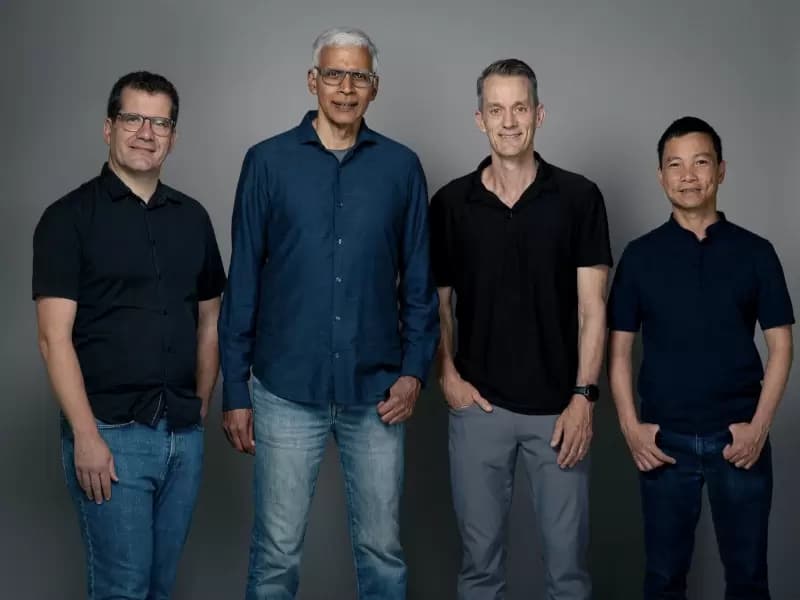
From left: Oriol Vinyals, Sanjay Ghemawat, Jeff Dean, and Quoc Le. / Credit: Discovery Loop
Indian-American computer scientist and Google veteran Sanjay Ghemawat on Aug. 5 announced the launch of Discovery Loop, an artificial intelligence startup focused on accelerating scientific discovery.
Ghemawat introduced the firm as a public benefit corporation he co-founded with longtime collaborators Jeff Dean, Google's chief scientist; Oriol Vinyals, former vice president of research at Google DeepMind; and Quoc Le, a co-founder of Google Brain.
Also Read: Emerson appoints Rudy Sengupta as chief technology and AI officer
The team said they are launching the company after working together for between 14 to 30 years on some of Google's most influential technologies.
Dean said Discovery Loop's mission is "to automate machine learning, science, and engineering to accelerate discoveries and progress."
Announcing Discovery Loop!
— Jeff Dean (@JeffDean) August 5, 2026
I am very excited to announce that, along with my longtime friends and collaborators @Sanjay_Ghemawat, @OriolVinyalsML and @quocleix, we are founding Discovery Loop (@DiscoLoopAI), a Public Benefit Corporation whose mission is to automate machine… pic.twitter.com/ancoplyNvN
"The four of us have worked together for 14 to 30 years, and have helped build some of the world's most used products, infrastructure and AI models, and we're excited to turn our attention to this ambitious endeavor," Dean wrote on X.
"We aim to automate the process of discovery and progress in machine learning, science, and engineering. The four of us have helped build some of the world's most used products and infrastructure. We're now excited to turn our attention to this ambitious endeavor," Ghemawat wrote on X, announcing the launch.
I am excited to announce that I, along with my long-time colleagues (@JeffDean, @OriolVinyalsML, @quocleix), are founding Discovery Loop (@DiscoLoopAI), a public benefit corporation. We aim to automate the process of discovery and progress in machine learning, science, and…
— Sanjay Ghemawat (@Sanjay_Ghemawat) August 5, 2026
According to the founders, Discovery Loop is developing AI systems that can automate the entire experimental process by proposing hypotheses, running experiments, evaluating results, and learning from the outcomes.
By combining frontier AI models with large-scale computational infrastructure, the startup aims to run thousands of experiments simultaneously, significantly reducing research timelines and accelerating scientific and engineering breakthroughs.
"Our mission is straightforward: we are building AI solutions that can automatically solve important problems in machine learning, science, and engineering," the founders said. "By advancing the pace at which we conduct engineering and scientific discovery, we can bring the benefits of science and technology to the world much faster."
The startup will initially focus on automating machine learning research and engineering, using its own technology to improve its AI systems before expanding into broader scientific fields.
Ultimately, the company said it aims to build AI systems capable of tackling major engineering and scientific challenges, including developing better medicines, advancing health informatics, making solar energy more economical, improving access to clean water, strengthening cybersecurity, and engineering new tools for scientific discovery.
Discovery Loop said its founding team includes three of the world's most-cited artificial intelligence researchers and two of the most-cited researchers in distributed systems.
The launch marks the departure of four senior Google AI leaders to pursue the venture. Collectively, the founders have helped develop technologies including Google Search, MapReduce, Google File System, Bigtable, Spanner, TensorFlow, TPUs, Gemini, AlphaFold, word2vec, sequence-to-sequence models, mixture-of-experts architectures, and multiple generations of large language models.
Google will retain an equity stake in Discovery Loop and provide computing resources during the company's first year of operations.
Google CEO Sundar Pichai welcomed the launch, writing on X, "Excited to see what this incredible team builds next. Congratulations and best wishes to @jeffdean, Sanjay Ghemawat, @OriolVinyalsML and the Discovery Loop team."
I also want to give a huge thanks to the incomparable @JeffDean after an incredible 27-year run at Google. He’s off to start his own public benefit corporation with @Sanjay_Ghemawat focused on accelerating discoveries across ML, science, & engineering. @Google will support as a…
— Sundar Pichai (@sundarpichai) August 5, 2026
Discovery Loop is also backed by Khosla Ventures and Radical Ventures, although the founders have not disclosed the size of the funding round or the company's valuation.
Reacting to the announcement, venture capitalist Vinod Khosla, founder of Khosla Ventures, wrote on X, "Super excited to back this super star team on its quest for huge impact. Could be larger than the impact that Google had when we backed them in 1998 at Kleiner."
Super excited to back this super star team at @khoslaventures on its quest for huge impact. Could be larger than the impact that @Google had when we backed them at Kleiner in 1998 and @OpenAI in 2018 at @khoslaventures https://t.co/AMBF9xlXyg
— Vinod Khosla (@vkhosla) August 5, 2026
Ghemawat is currently a senior fellow in Google's Systems Infrastructure Group and is widely regarded as one of the architects of modern distributed computing. Born in West Lafayette, Indiana, and raised in Kota, Rajasthan, he studied at Cornell University before earning a Ph.D. from the Massachusetts Institute of Technology in 1995.
He joined Google in 1999 after working at the DEC Systems Research Center, where he began his long-running collaboration with Dean. Together, they helped develop foundational technologies that underpin Google's global computing infrastructure, including MapReduce, Google File System, Bigtable, Spanner, Protocol Buffers, TensorFlow, LevelDB, and Service Weaver.
Ghemawat was elected to the National Academy of Engineering in 2009 for his contributions to large-scale distributed computer systems and was inducted into the American Academy of Arts and Sciences in 2016. In 2012, he and Dean received the ACM Prize in Computing for their pioneering work on internet-scale infrastructure.
Discover more at New India Abroad.
ADVERTISEMENT
ADVERTISEMENT
Comments
Start the conversation
Become a member of New India Abroad to start commenting.
Sign Up Now
Already have an account? Login